
The Odeon of Ephesus is easy to mistake for a miniature version of the Great Theatre. Its tiers of stone seats do invite that comparison, but its position beside the State Agora tells a more interesting story. This was part of the upper city's civic landscape, where public gathering, administration and ceremonial space met. A visit here rewards a slower look at the building and at the square beside it.
Find the Odeon in the upper city
The UNESCO Ephesus nomination dossier places the Bouleuterion, also called the Odeon, on the north side of the State Agora. It dates the building to the middle of the second century CE on the evidence of an inscription. The same dossier records its nineteenth-century discovery, excavation in 1908 and conservation work carried out by the Ephesus Museum Directorate between 1970 and 1990. Those dates describe different stages in the monument's history; they should not be confused with the date of its original construction.
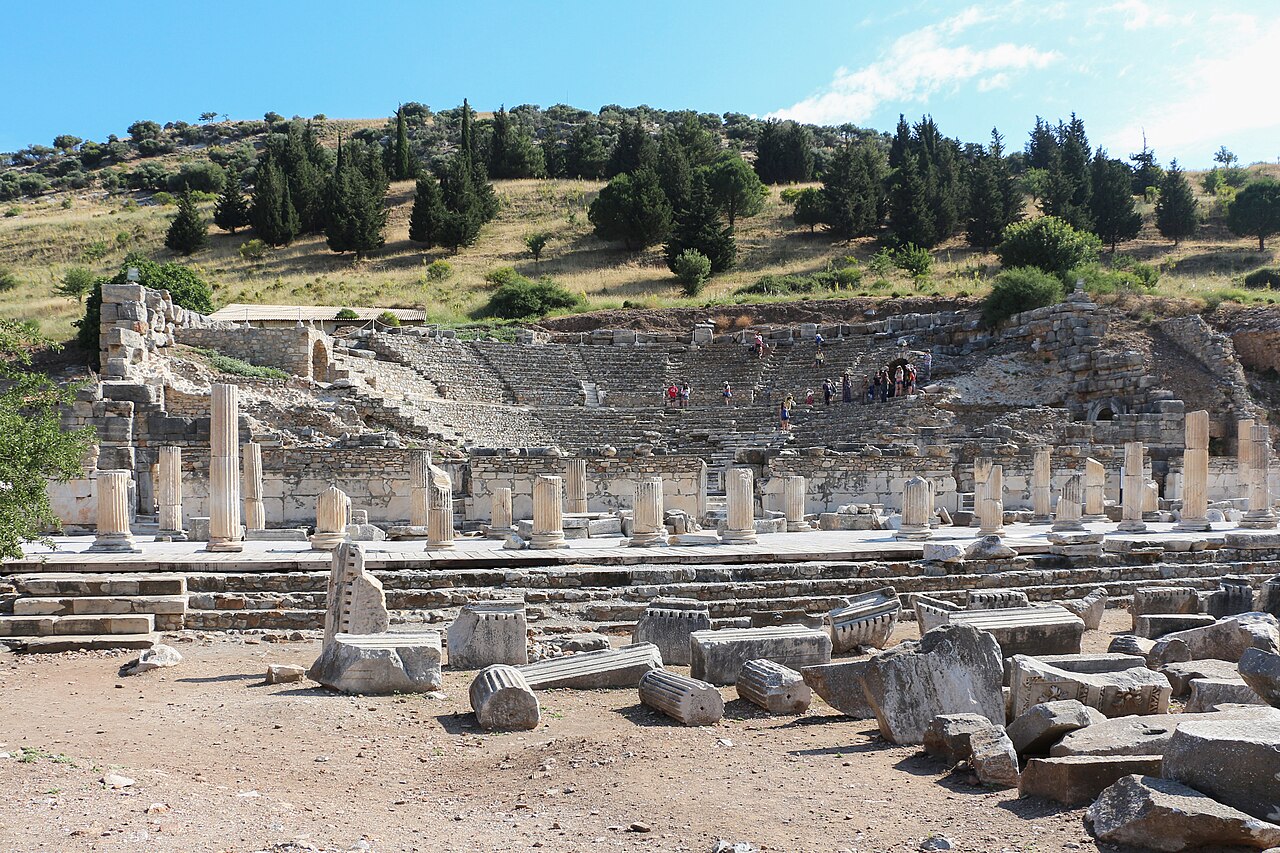
To understand its setting, first look toward the open area of the State Agora. The square was a public centre of the Roman city, distinct from the commercial market near the Library of Celsus. The Odeon belonged to this upper quarter rather than to the harbour-side trading area. A site map helps you see that relationship before individual ruins begin to blur together.
Approach by the marked visitor path and pause where you can see both the seating and the surrounding ground. The surviving form is familiar: curved rows face a performance or speaking area. Yet the label “Bouleuterion” points to civic assembly, while “Odeon” suggests musical or other performances. The paired names are useful because they keep the building's possible public roles in view without pretending that every event held here is documented.
Read the seats and the setting together
The Turkish Ministry of Culture and Tourism describes the Odeon as a council and concert hall. That concise description is a helpful starting point, but a visitor should resist turning it into a detailed reconstruction of one particular meeting. We can identify the building and its civic setting; the surviving stones do not tell us who spoke on a specific day, what was debated or exactly how a performance sounded.
Look along the tiers and imagine the practical problem of bringing an audience into a compact space. Where might people have entered? How did the rows relate to the floor below? Which elements appear ancient, and which have been stabilised or restored for today's visitor? Archaeological presentation often combines original fabric with later conservation. Reading the signs and noticing the joins makes the visit more rewarding than treating the monument as an untouched scene.
Then turn away from the seats and look at the State Agora again. A building for assembly gains meaning from its neighbours: the square, the Prytaneion and the streets of the upper city. The UNESCO dossier identifies the Prytaneion as an important administrative building associated with the city's sacred hearth. These places had different functions, but their proximity helps a visitor recognise a concentrated civic district rather than a collection of disconnected photo stops.
Compare it with the Great Theatre
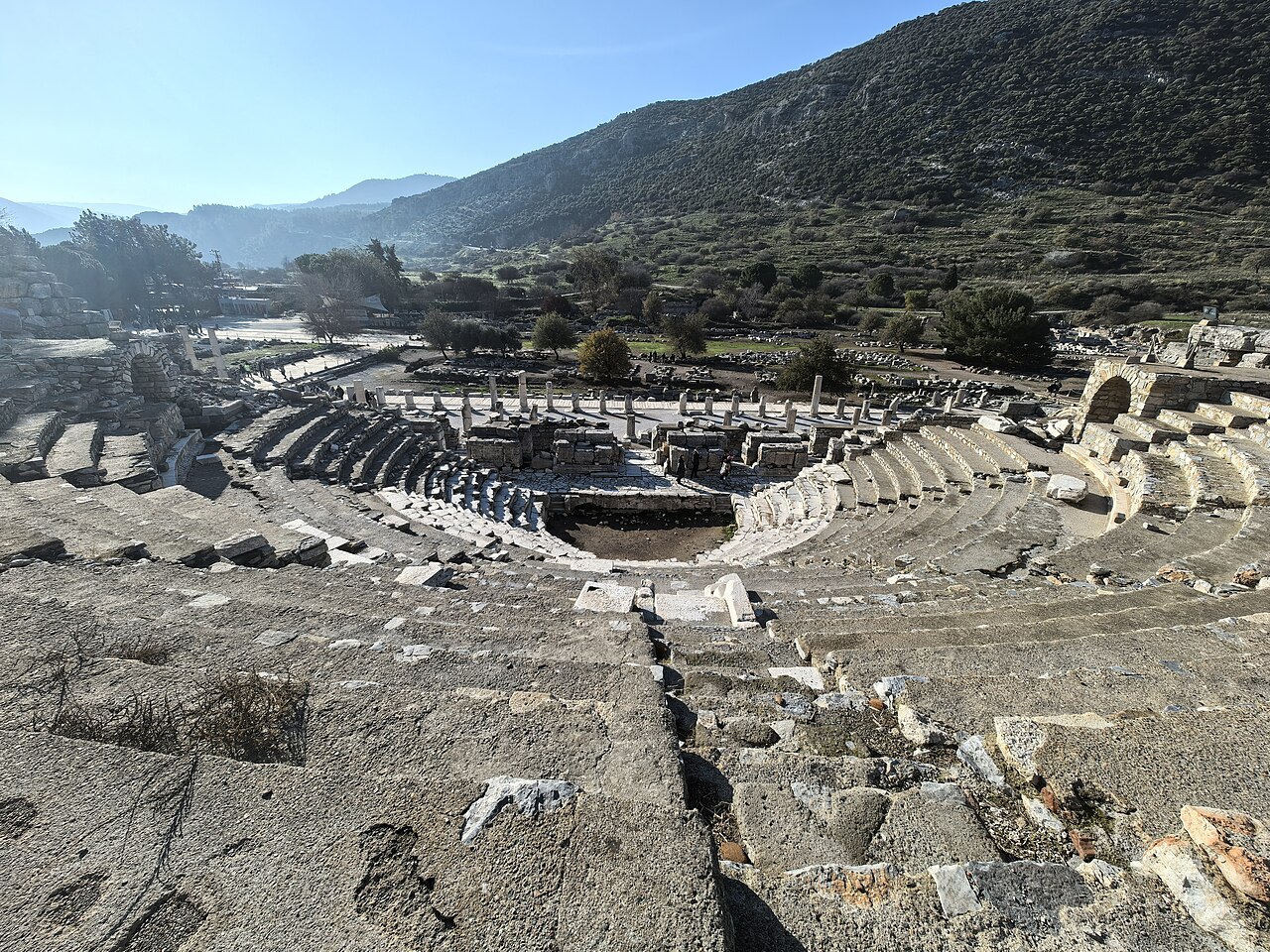
Many travellers remember Ephesus for the immense Great Theatre. Comparing it with the Odeon is useful, provided you do not reduce the smaller building to a rehearsal space. The monuments sit in different parts of the ancient city and answer different questions about public life. The Great Theatre dominates a broad urban vista. The Odeon asks you to pay attention to the upper city's more compact civic setting.
Scale changes the feeling of a place. At the Odeon, it is easier to follow the curve of the seats with your eye and to picture a gathering without inventing a precise ancient scene. From a permitted viewpoint, take one photograph that includes the whole building and another that records its relationship to the surrounding square. Those images will explain more later than a close-up that could have been taken at any ancient theatre.
The two buildings also show why a route through Ephesus should not be rushed from one famous façade to the next. Between them are streets, open spaces and structures that made the city work. Our Ephesus walking route guide can help you place this stop in a wider visit. Allow time to read the site interpretation and adjust your route to the access conditions you find on the day.
Plan a thoughtful stop
Use the official archaeological-site page to verify current visitor information before travelling. Opening arrangements, ticket rules and access to particular areas may change, so a photograph or an older travel article is not a reliable source for today's conditions. Wear shoes suited to uneven stone and exposed paths. Carry water, stay within the marked route and give yourself time to rest; the upper city can feel very different from a quick glance at a map.
If you travel with someone who needs step-free access or a slower pace, discuss the route before setting out. Ancient surfaces and conservation boundaries can limit where a visitor can go. Our accessibility guide explains planning questions to raise, but the current site operator's instructions should govern the visit. A guide can help connect the Odeon to the State Agora and Prytaneion while adapting the order of stops to the group's needs.
For a private visit, compare the stops and inclusions on the private Ephesus tour page and share your departure point, date and walking preferences when asking for a written plan. The Odeon is worth discussing as a deliberate stop, especially if you want the story of Ephesus to include its civic buildings as well as its best-known monuments. Its strength is not size: it is the way one compact structure makes the upper city's public life easier to picture.
Sources and further reading
Explore Ephesus / Upper City with context.
Review the route and inclusions before requesting your own private itinerary.
EXPLORE PRIVATE EPHESUS TOURS