
The Library of Celsus and the great theatre tell Ephesus's public story. Inside the Terrace Houses, the scale changes. Rooms, painted walls and mosaic floors bring a visitor closer to the choices people made in a Roman home. These remains do not offer a complete picture of every Ephesian household. They do, however, let us ask a more intimate question: how did a wealthy household organise space, work and display within a busy city?
Begin with the hillside
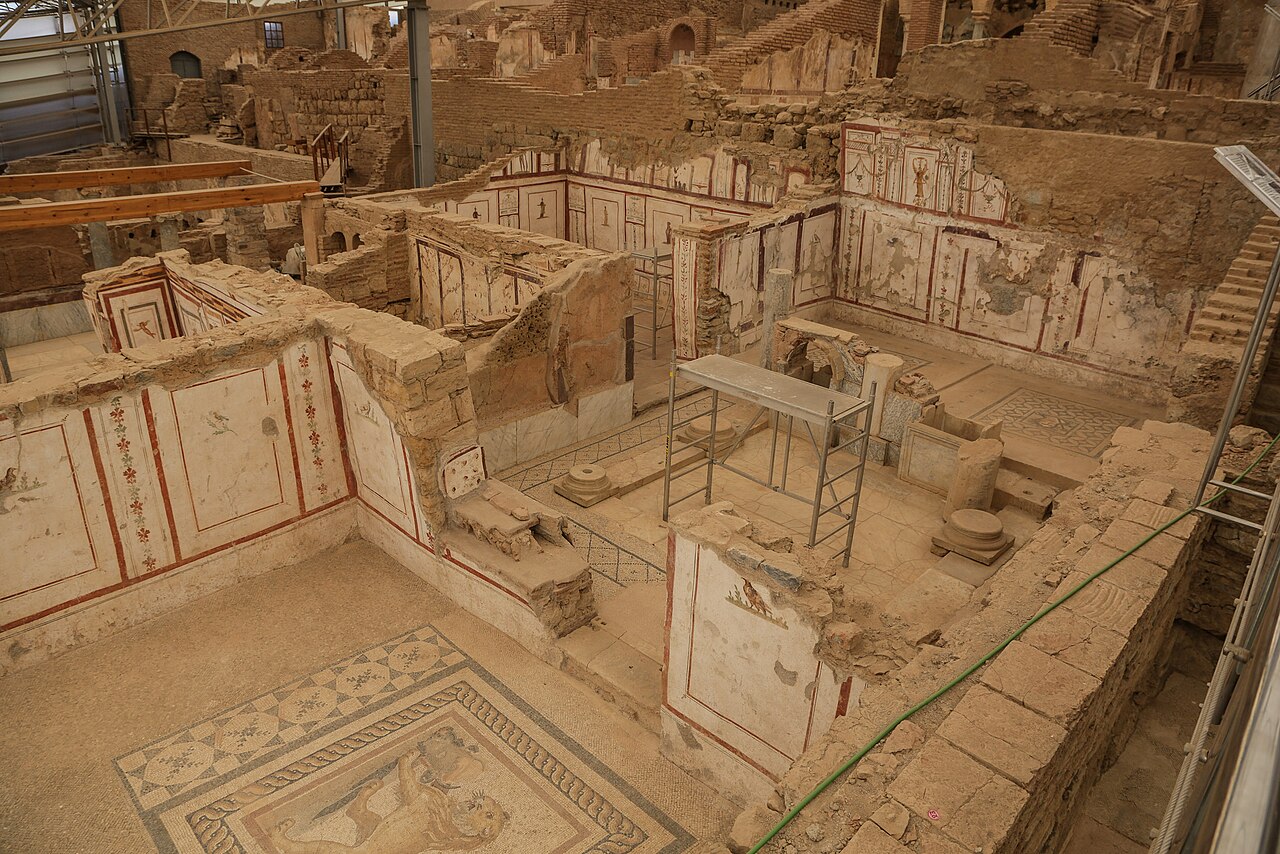
The houses occupied a slope beside the city's central streets. UNESCO's Ephesus nomination describes Terrace House 2 as a large urban block arranged over three terraces, originally divided into six residential units with separate entrances. The level difference matters. What looks like a jumble of walls from one angle becomes a sequence of rooms and courtyards when viewed from above. Pause at a safe viewpoint before following any detail. Trace the boundaries of one unit with your eyes and notice how an adjacent household could sit at a different height.
The nomination places the construction of these Roman-period units in the early imperial era and records later rebuilding and changes. An ancient house was not a frozen design. Owners altered rooms, finishes and connections over generations. A surviving floor may therefore belong to a different phase from a nearby wall. Avoid reading the complex as a single family home made at one moment. Archaeologists use masonry, decoration and finds to untangle its changing history.
Follow a room's edges
On a broad tour, a mosaic can become a quick photograph. Here it helps to look first at the room around it. Where does the border stop? Does the design draw attention toward the centre, or frame movement around a wall? Small pieces of stone and glass were laid into patterns that worked with a room's proportions. Their placement also reminds us that floors were walked on, furnished and seen under changing light. The surviving surface is an archaeological document as well as an artwork.
UNESCO identifies mosaics, wall paintings and marble panelling as evidence of the living standards of Ephesus's upper social levels. That wording is important. The decorations represent a particular social setting; they cannot stand for everyone in the city. Most working households left much less visible material. Looking carefully at an elite interior can still be useful if we keep that imbalance in mind. The decoration tells us what some residents chose to show, not what all Ephesians possessed.
Read the geometric floor
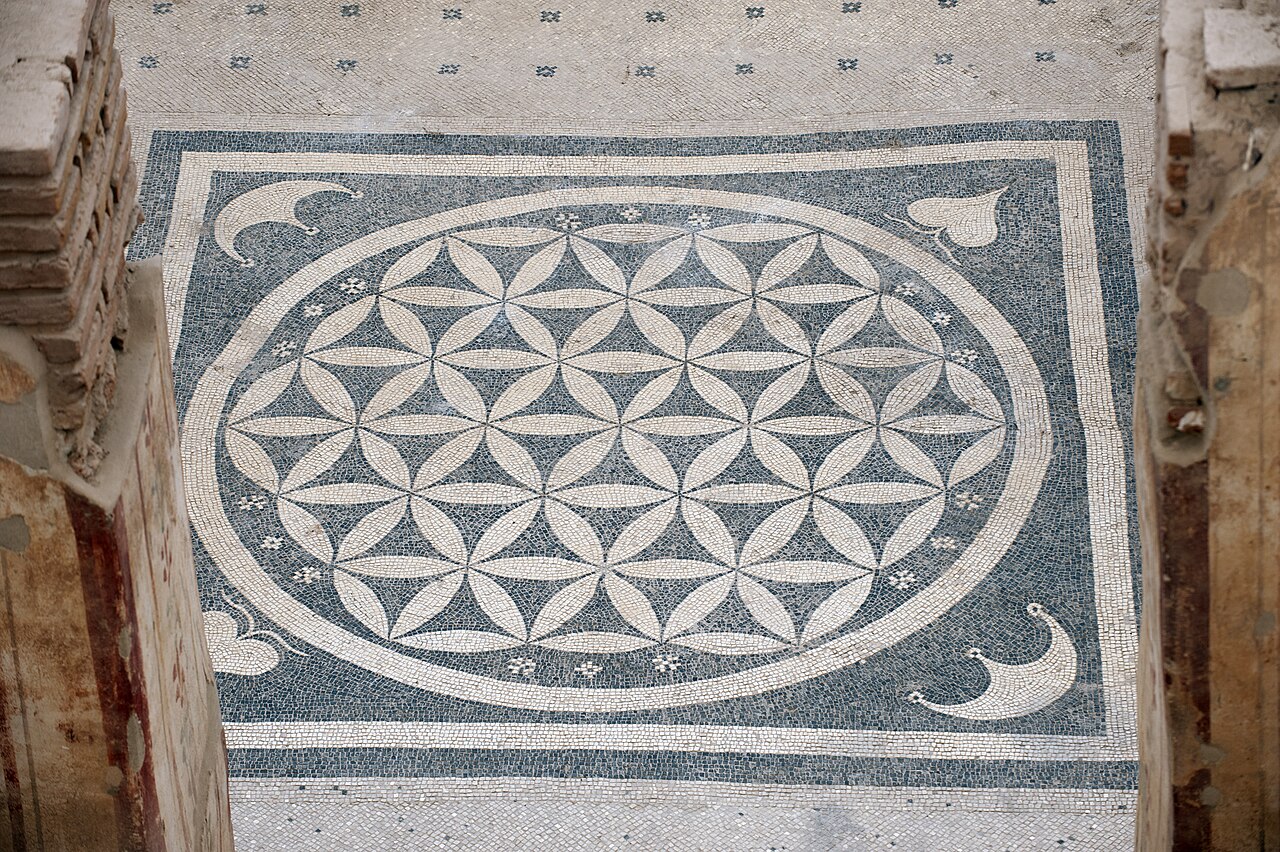
One preserved mosaic uses intersecting curves and repeated shapes. Step back and the overall geometry becomes clear; look closer and individual tesserae reveal the labour needed to make it. Follow the outer border around the design. It separates the central pattern from the more regular field beyond, giving a room a visual centre even without furniture. We cannot reconstruct every use of this exact space from the floor alone. We can observe how its makers used repetition and contrast to organise what a visitor would see.
Look up from the floor
The floors make most sense alongside the walls. Painted panels and marble surfaces could give separate rooms different characters. In the protected complex, a high walkway may let you see several rooms at once. That perspective is invaluable for understanding the plan, although it is not the view ancient residents had while moving through their homes. Try alternating between the wide view and one detail: a painted border, a doorway or a change in paving. Together they tell more than either view alone.
The UNESCO nomination also notes water supply and drainage systems, and distinguishes richly decorated reception areas from plainer work areas such as kitchens and toilets. A household needed practical infrastructure as well as art. When you see channels or utilitarian spaces, do not skip over them. They are clues to the labour that kept these residences running. The contrast between a reception room and a service area can reveal how domestic life was arranged, even where upper storeys no longer survive.
What survived, and what did not
Earthquakes in the third century contributed to the end of occupation in parts of the complex, according to the UNESCO nomination. Destruction is one reason objects and architectural phases can remain archaeologically legible, but it should not be turned into a simple disaster story for every visible room. Excavation and conservation have also shaped what visitors see today. A roof, barriers and walkways protect fragile material and create the route through it. They are modern tools for looking after the past, not parts of a Roman house.
Allow the gaps to remain visible. A fragmentary painting should not be imagined as a complete wall without evidence, and a surviving mosaic does not reveal the exact furniture once placed above it. Careful interpretation is more rewarding than filling every missing piece with certainty. The Terrace Houses are powerful precisely because they let you see both exceptional survival and the limits of what can be known.
Plan a slower visit
The Turkish Museums ticket page identifies the Terrace Houses as a separately ticketed area within the Ephesus archaeological site. Check the official listing before you go; admission arrangements and access may change. Our Ephesus ticket guide points to current official sources, while the Terrace Houses monument guide introduces the site as a whole. This article focuses on how to look at its domestic decoration.
Give the complex time rather than treating it as a detour between famous monuments. Follow marked paths, respect barriers and avoid flash or other photography where signs prohibit it. The route uses elevated walkways and changes of level; ask the site about current accessibility if stairs are a concern. A guided visit can connect a room's details to the wider city, but confirm any Terrace Houses stop and separate admission in your written itinerary. Our private Ephesus tour is a place to begin that conversation.
As you leave, compare the scale of a patterned floor with the monumental street outside. Both belong to Ephesus, yet they communicate different forms of life. The houses do not replace the city's grand landmarks. They add a smaller, more human scale to them, one careful room at a time.
Sources and further reading
Explore Ephesus with context.
Review the route and inclusions before requesting your own private itinerary.
EXPLORE PRIVATE EPHESUS TOURS