
The Temple of Hadrian is one of the familiar monuments on Curetes Street. Across the same part of Ephesus stands another structure with a similar name: Hadrian’s Gate. They are separate monuments. The gate helps explain how the street connected with other routes through the ancient city, while its surviving columns and fragments invite a closer look at what has been preserved and what has been reconstructed.
Locate the gate at a crossroads
The Ephesus World Heritage nomination places Hadrian’s Gate opposite the Temple of Hadrian, near the route toward the Terrace Houses. It describes this part of Curetes Street, also known as the Embolos, as a junction within the city. That position matters more to a visitor than memorising an architectural date: the gate marked movement between important urban spaces, rather than simply framing a single building. Look at it in relation to the slope of the street and the adjoining approaches.
If you are walking downhill, pause before reaching the Library of Celsus. Use the Temple of Hadrian guide to identify the smaller monument on the street, then turn your attention to the gate across the route. The two names are easy to confuse in photographs or on a hurried itinerary. A gate is an urban passage; the temple is a distinct building with its own history. The surviving stones need not give a complete picture of either ancient facade.
The nomination also associates the gate’s location with the route toward Ortygia. Treat that as a clue to the city’s wider network of ceremonial and everyday movement, not as a modern walking route to follow without guidance. Today's permitted paths, barriers and site access determine where visitors can stand. The broader landscape is easier to understand when you compare a current site plan with the streets visible from the junction.
Read the surviving architecture carefully
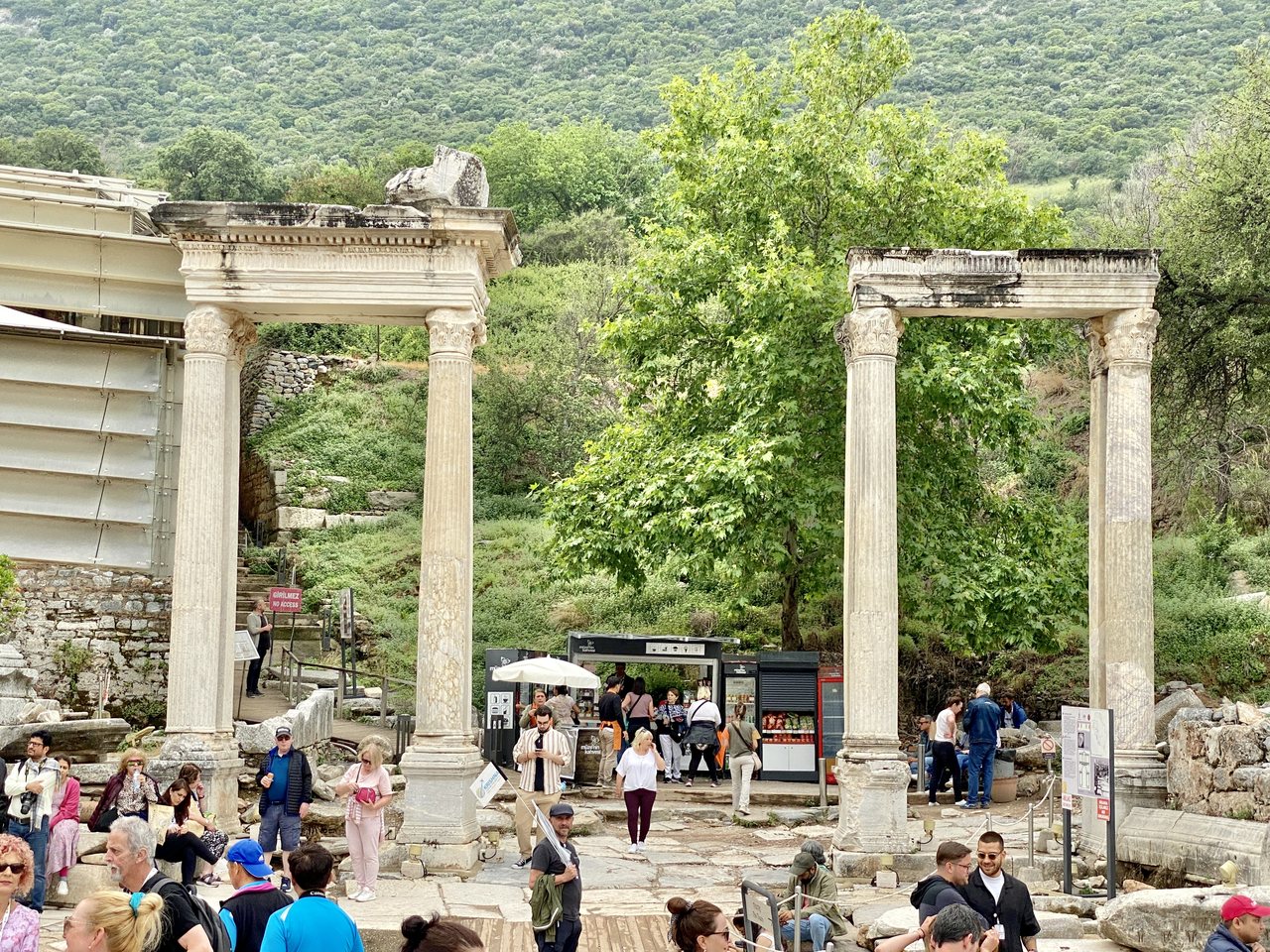
The World Heritage nomination calls the original gate a tall, three-storey structure associated with Hadrian’s period. It notes that the first storey was restored and that the design used columns in front and supporting columns behind. A visitor today sees only a partial version of the ancient monument. That is why a photograph cannot stand in for a full reconstruction: missing upper levels and later intervention change the apparent proportions.
Look first for the passage and its relation to the street. Then notice how the architectural pieces create depth rather than a flat screen. Where stone surfaces differ, ask whether you are looking at an ancient fragment, a reassembled piece or modern conservation work. A guide or official site interpretation can help with details that are not obvious from the public path. Avoid treating every visible joint as evidence for a particular ancient construction phase.
UNESCO describes Ephesus as an exceptional record of Hellenistic, Roman Imperial and early Christian traditions. Hadrian’s Gate is a small part of that larger urban record. It is especially useful for seeing how monuments shape a visitor’s route through a city. From here, the Curetes Street guide gives a broader street-level context, while the nearby Terrace Houses guide introduces a very different scale of Roman life.
Compare two views of the same gate
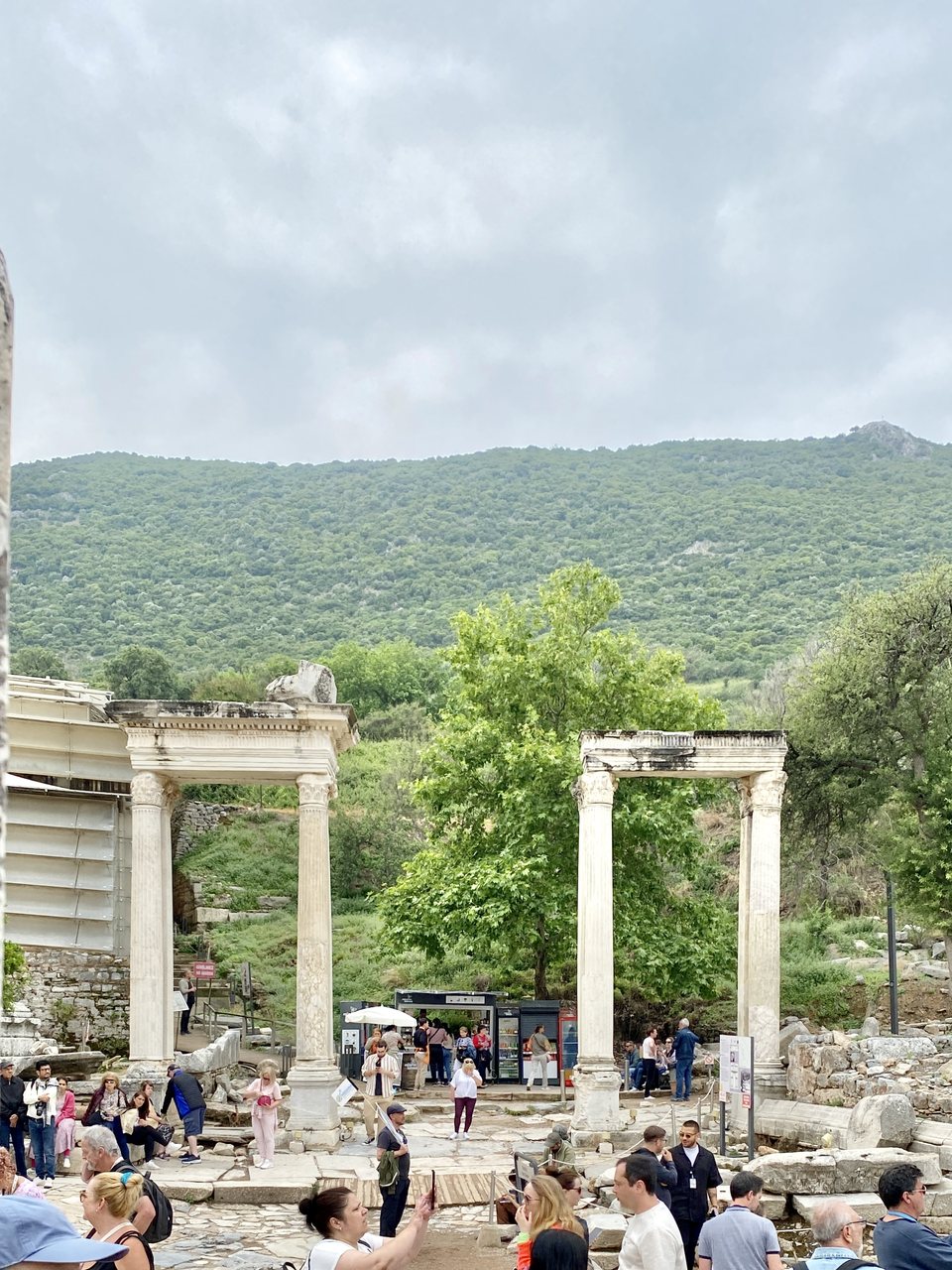
Move a short distance along the permitted path and look back. The change in angle can reveal which parts project from the gate and how it sits beside the street. If the site is crowded, wait for a clear view rather than stepping into a closed area. A second photograph, taken close to the monument, is useful here because it records the gate from another angle; it does not show a second gateway.
This exercise also helps with the common temptation to treat Ephesus as a row of unrelated postcard views. The gate belongs to a sequence: street, crossroads, neighbouring buildings and the turn toward lower Ephesus. The Library of Celsus may draw the eye, but the spaces between the famous landmarks explain how a visitor moved through the ancient city. Stand back far enough to see those relationships before concentrating on decoration.
Plan a useful stop on an Ephesus visit
Allow a few minutes for the junction instead of walking directly from the temple to the library. Find both monuments on a current site map, compare the directions of the surviving streets and photograph the gate from a public viewpoint. Uneven stone paving and exposed sun can make a slow, attentive stop more comfortable than a rushed one. Carry water and wear shoes suitable for archaeological ground.
Check the official site authority for current entry, conservation and access arrangements before travelling. Do not rely on an older photo to assume that a particular section is open. If the gate and the Terrace Houses are priorities, discuss them when arranging a private Ephesus tour; a route should reflect the visit date, access conditions and your interests. Cruise visitors can also compare the Ephesus shore excursion options and leave enough time for the return journey.
Hadrian’s Gate rewards a different kind of attention from a large, intact facade. It asks you to read a crossroads, to distinguish a gate from a nearby temple and to recognise the limits of what the surviving stone can tell you. Taken together with Curetes Street and the Terrace Houses, it adds a clearer sense of movement and scale to a visit through Ephesus.
Sources and further reading
Explore Ephesus / Curetes Street with context.
Review the route and inclusions before requesting your own private itinerary.
EXPLORE THE PRIVATE EPHESUS TOUR