
A visitor to Ephesus can easily remember its marble facades and forget the water that made daily life possible. The city's public fountains offer a different way to read the ruins. They were places to collect water, but also carefully designed statements about donors, civic generosity and the city's connection to its surrounding landscape. Follow two fountain sites and an archaeological museum display to see how a practical network became part of the public face of Roman Ephesus.
Start with the question behind the stone
Where did water come from before it reached a fountain basin? The Austrian Archaeological Institute explains that Roman Ephesus invested in aqueducts bringing fresh water from the mountains into a growing city. Water then passed through a network serving public fountains and other urban needs. A fountain's surviving facade is therefore only the visible end of a much larger system. Looking for channels, basins and pipe routes can be more revealing than looking for sculpture alone.
It is tempting to imagine every ancient basin filled as it once was. What visitors see now is archaeological fabric, not an operating public water supply. Stone may have been moved, restored or conserved after excavation. Read the site as evidence of a working city while allowing for those changes. The Ephesus walking route guide helps place these monuments within a longer visit.
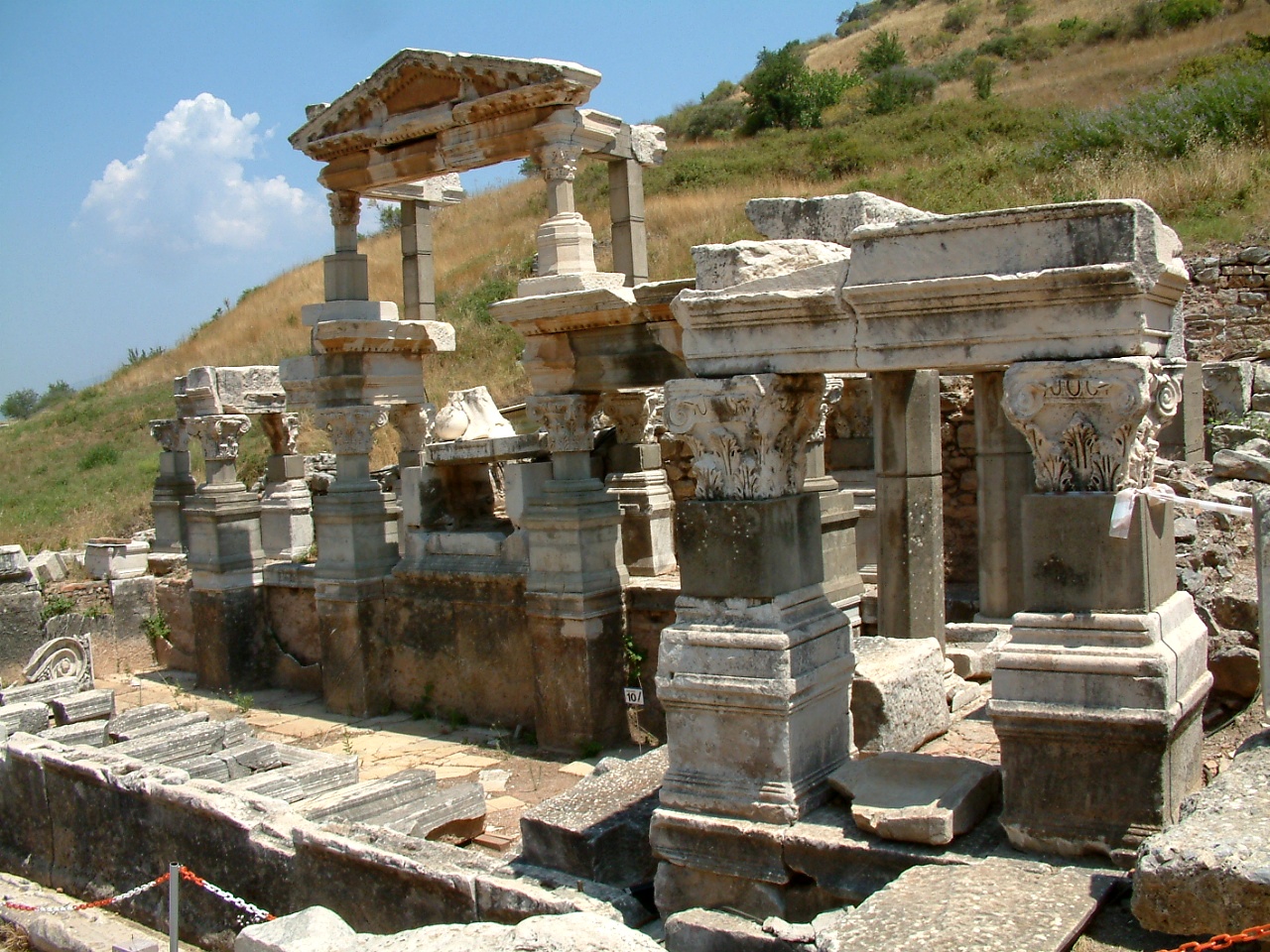
The Nymphaeum Traiani on Curetes Street
The Nymphaeum Traiani stood on Curetes Street, the route connecting the lower and upper areas of the ancient city. According to the Austrian Archaeological Institute, it marked the end of a long pipeline supplying drinking water. Residents could draw water here, and water was also directed to nearby houses. That combination of public collection and distribution makes the monument more than a decorative stop. It shows how an important street and a piece of infrastructure could meet.
Stand back far enough to see the outline of the facade before examining the basin. Imagine approaching along the street rather than looking at the ruins in isolation. The monument would have been encountered amid shops, movement and other public buildings. Its architectural display advertised the benefaction that brought water into the city. The institute links the foundation to the family of Tiberius Claudius Aristion, a powerful Ephesian in the early second century CE, and notes a possible family burial nearby. The burial connection remains an interpretation, so it is better presented as such than as a certain fact.
What the Pollio Fountain adds
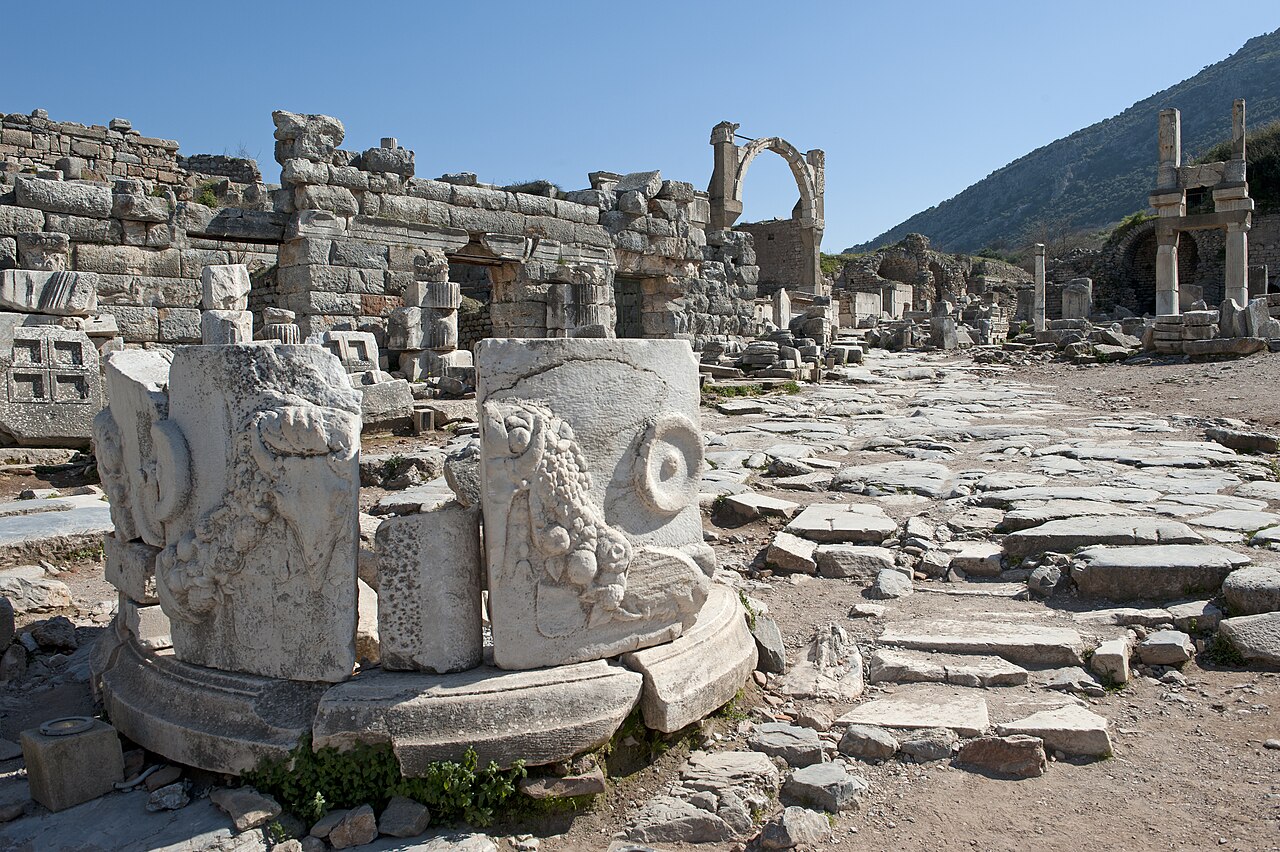
The Pollio Fountain gives another perspective on public water and display. Its surviving architecture does not reproduce the whole ancient experience, yet it rewards a deliberate pause. Look for the relationship between the arched structure, the basin area and the route around it. The site has changed over time, and a photograph can flatten those relationships. Moving a few steps to compare the fountain with nearby monuments often explains more than a close-up of one fragment.
The Turkish Museums description of the Ephesus Museum identifies a resting warrior sculpture as a find from excavations at the Pollio Fountain. That detail is a useful reminder that important pieces may now be displayed elsewhere for study and care. The open-air site and the museum tell connected parts of the same story. Do not assume every sculpture shown in a reconstruction still stands in its original location. When a label names an object's excavation context, it can reconnect a gallery display to the place where it was found.
Water, donors and the urban landscape
The Austrian Archaeological Institute describes Ephesian nymphaea as more than utilitarian structures. Their architecture and sculpture made the generosity of wealthy patrons visible. The city's need for water and a donor's wish to be remembered could reinforce one another. A basin invited repeated everyday use; a facade made that use part of a public monument. This does not mean that every resident experienced the network in the same way. Archaeological remains preserve monumental points of access more clearly than the ordinary routines of many households.
Water also changed the way a street was perceived. A person crossing Curetes Street encountered monuments at a walking pace, not as isolated entries in a guidebook. The sound and movement of water would have given a working fountain a presence that bare stone cannot fully recreate today. We can reasonably infer that an operating basin felt different from the dry remains, but we cannot recover its precise sound, flow or appearance at every phase. Let that distinction sharpen, rather than diminish, your reading of the place.
For broader context, UNESCO identifies Ephesus as a Roman port city whose settlement shifted as the coastline changed. Its landscape was dynamic, and water management was one part of adapting to that setting. Keep the ancient port and public fountains in separate scales of view: one concerns the wider environment and trade; the other brings infrastructure down to a place where a person could collect water.
Make a practical route of it
Use the Nymphaeum Traiani guide and Pollio Fountain guide for site-specific orientation, then look at each monument in person before reading its details. Start with a wide view, identify the basin or water-facing side, and only then search for decorative fragments. Where signs or barriers limit access, stay on the marked route. The ruins are fragile, and different viewpoints may be available as conservation work changes.
Consider adding the Ephesus Museum in Selçuk on another part of the day if you want to connect architectural settings with excavated objects. Check current access, tickets and museum information with the official operator before travel; these details can change. Carry drinking water for your own visit, but never treat an ancient basin as a present-day drinking source.
A private visit can leave room for the smaller monuments between famous landmarks. If these fountain stops matter to you, ask for them explicitly when discussing an Ephesus private tour, and confirm the written itinerary and admissions. The reward is a view of Ephesus as a supplied, inhabited city: one where water arrived through engineering, appeared in public architecture and became part of the rhythm of everyday movement.
Sources and further reading
Explore Ephesus with context.
Review the route and inclusions before requesting your own private itinerary.
EXPLORE PRIVATE EPHESUS TOURS