
Many photographs of Ephesus begin at the Library of Celsus. For a different view of the city, walk toward the upper civic quarter and pause near the State Agora. Here the Prytaneion reveals how public authority, ceremonial life and architecture could meet in one place. Its standing columns and scattered masonry do not offer an intact building to enter. They invite a slower reading of a district whose purpose differed from the commercial market in the lower city.
Locate the Prytaneion in the civic quarter
UNESCO's Ephesus nomination describes the Prytaneion among the important buildings around the State Agora. It separates this upper civic space from the Tetragonos Agora, the commercial market nearer the Library of Celsus. Those two agoras should not be merged into one generic “Roman marketplace.” The distinction is useful while walking: the lower market suggests trade and movement of goods, while the upper square and its neighbouring buildings point toward public administration and civic ceremony.
The Turkish Ministry of Culture and Tourism identifies the Prytaneion as a municipal or civic building. Its visitor information places the complex opposite the State Agora. Use that relationship as an orientation aid rather than relying on a single column or a cropped photograph. A surviving upright can be visually striking, but its setting explains why the structure mattered. From a permitted viewpoint, look across the adjacent ruins and ask how someone moving through the upper city would have approached the square.
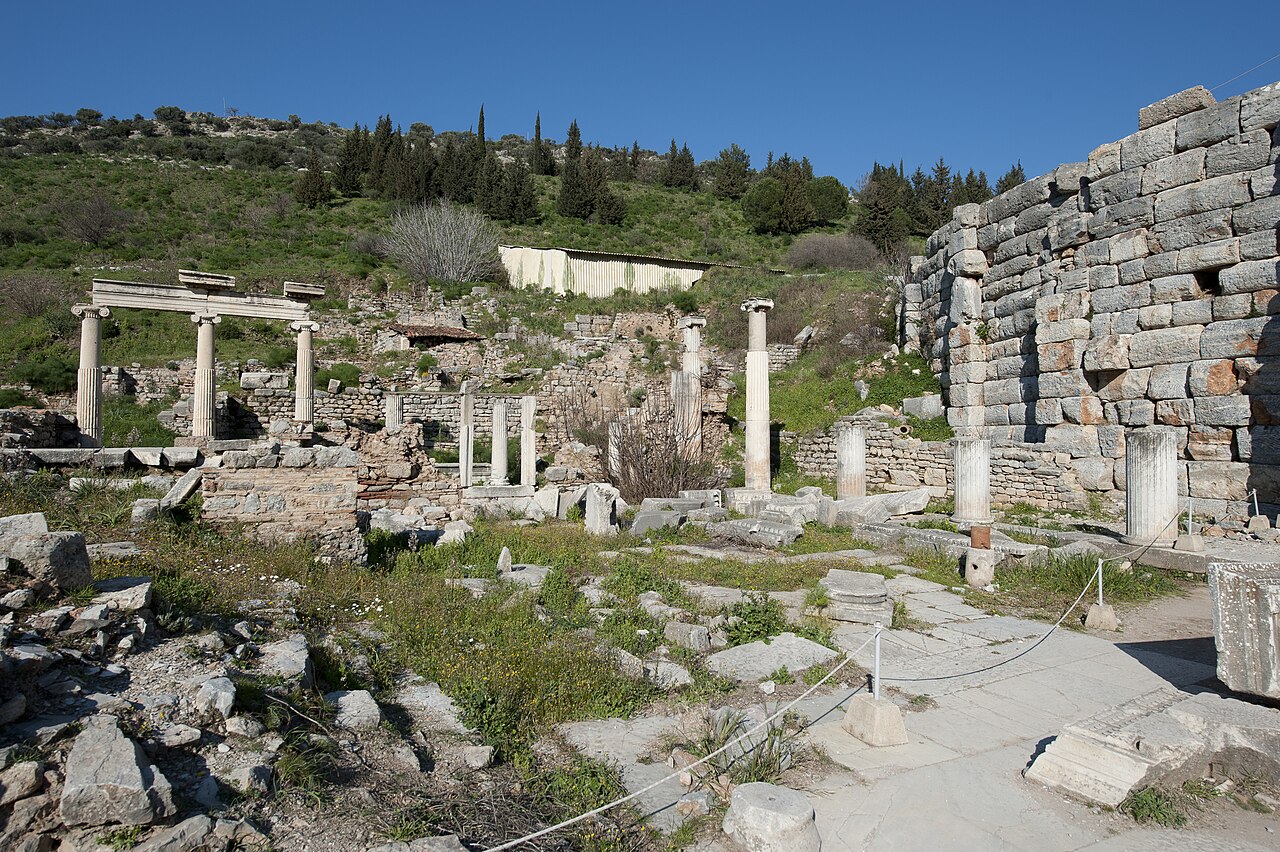
What a civic building can tell us
A prytaneion in a Greek city was associated with public officials and civic ritual. At Ephesus, the ministry's account connects the building with the sacred fire and the cult of Hestia. That context helps explain why it should be understood as more than an administrative office. Public decisions and religious practice were not always divided into the modern categories we use today. The building's significance lies partly in this overlap, even though much of its original form has been lost.
Do not mistake the surviving fragments for a complete floor plan that can be read without archaeological work. Columns may have been re-erected; walls and foundations survive to different heights; and individual stones have complicated histories. The nomination file is useful precisely because it places the monument in a wider archaeological landscape. On site, compare the standing elements with the low remains around them. The contrast between visible height and missing volume is part of the story, not an invitation to fill gaps with certainty.
The local museum's visitor material also links Artemis finds with the Prytaneion. That connection can be explored further at the Ephesus Museum in Selçuk, where objects found at the archaeological site are displayed in a different setting. An object in a museum and a ruin in the landscape answer different questions. The former can be examined closely; the latter retains the spatial relationship between buildings. Visiting both can make the history more intelligible without claiming that every find remains at its original location.
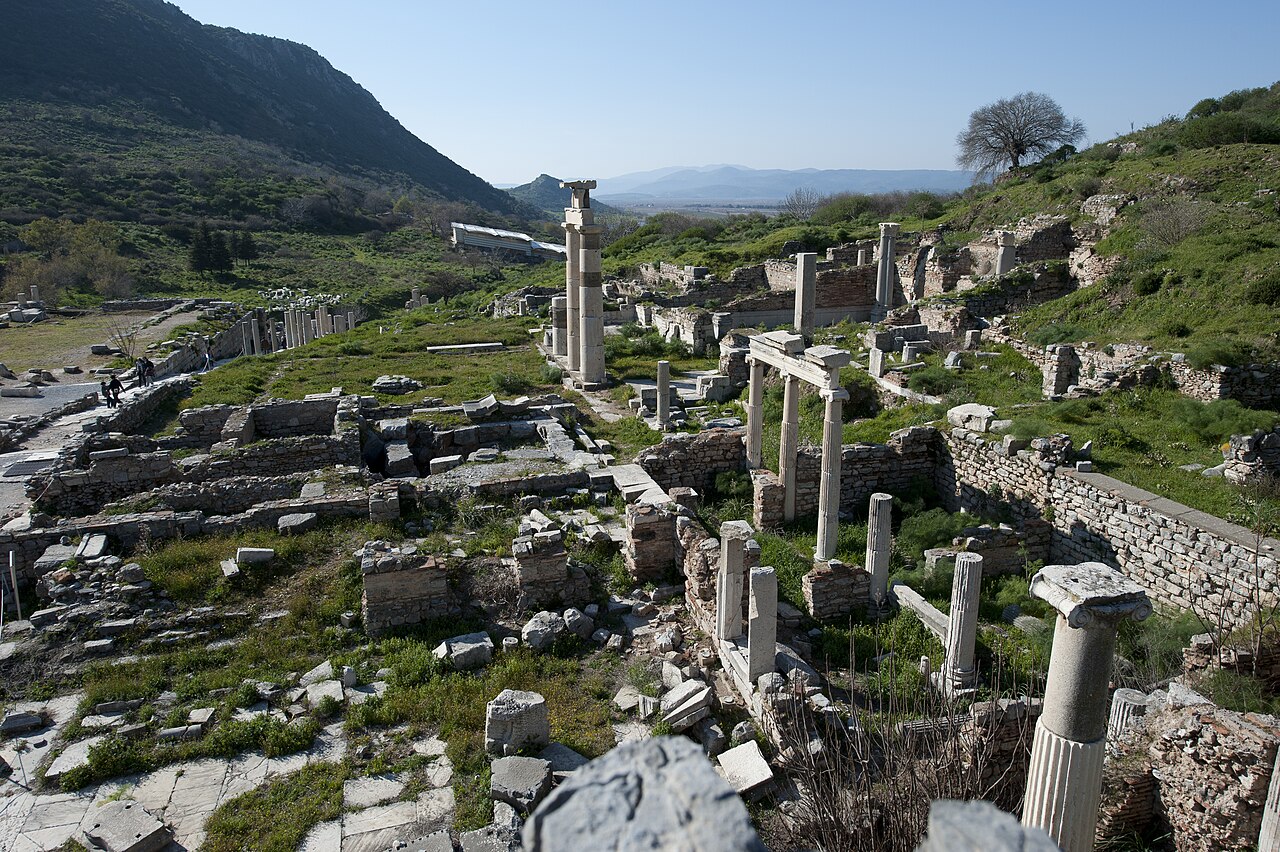
Compare the two agoras without confusing them
Walk through Ephesus with a simple mental map: the State Agora belonged to the upper civic district, while the Tetragonos Agora served a commercial role in the lower city. Our article on the Gate of Mazaeus and Mithridates explains a threshold into the latter market. The Prytaneion offers a contrast. A visitor who reads both places can see how the city distributed public activity across distinct spaces rather than concentrating every function in one square.
This comparison does not require a rushed march between monuments. Allow time to notice the change in scale, topography and surviving fabric. The lower quarter's monumental library façade often dominates attention. The upper civic area asks for more interpretation because many structures survive only in part. A licensed guide can help connect the places, but the first step is simply to keep their names and roles separate. The term “agora” alone is not enough to explain what happened in each one.
Our Ephesus walking route can help you place the upper and lower quarters in a larger visit. Routes and accessible viewpoints may change as conservation work continues. Follow the signs on the day rather than assuming that a photographed angle is reachable. Some stones look close from a distance but lie beyond a barrier protecting fragile remains. A clear mental map is more valuable than a photograph taken from an unsafe position.
Plan an attentive stop
Begin with a wide view of the State Agora and its neighbouring ruins. Identify the Prytaneion using the site's interpretation rather than guessing from a single architectural feature. Then look from another permitted angle to see how much of the building survives and how much must be reconstructed through research. Take one contextual photograph before moving closer; it will help you remember the relationship between the monument and the square. The two images in this article illustrate that difference between a building detail and its setting.
Ephesus has exposed stone surfaces and uneven walking areas. Comfortable shoes, water and sun protection make an unhurried visit easier. Check official site information shortly before travelling for current access arrangements and any temporary restrictions. We do not quote a fixed ticket price, opening hour or guaranteed route, because these can change. If you are considering a private Ephesus tour, ask for the proposed stops and inclusions in writing before booking.
The Prytaneion is a rewarding place precisely because it resists the instant postcard view. It asks visitors to connect a fragmentary building with a civic square, museum finds and the city's wider plan. When you later reach the commercial agora, the contrast becomes clearer: Ephesus was not one famous street lined with isolated highlights. It was a city of linked districts, each with a different public role.
Sources and further reading
Explore Ephesus / State Agora with context.
Review the route and inclusions before requesting your own private itinerary.
EXPLORE PRIVATE EPHESUS TOURS