
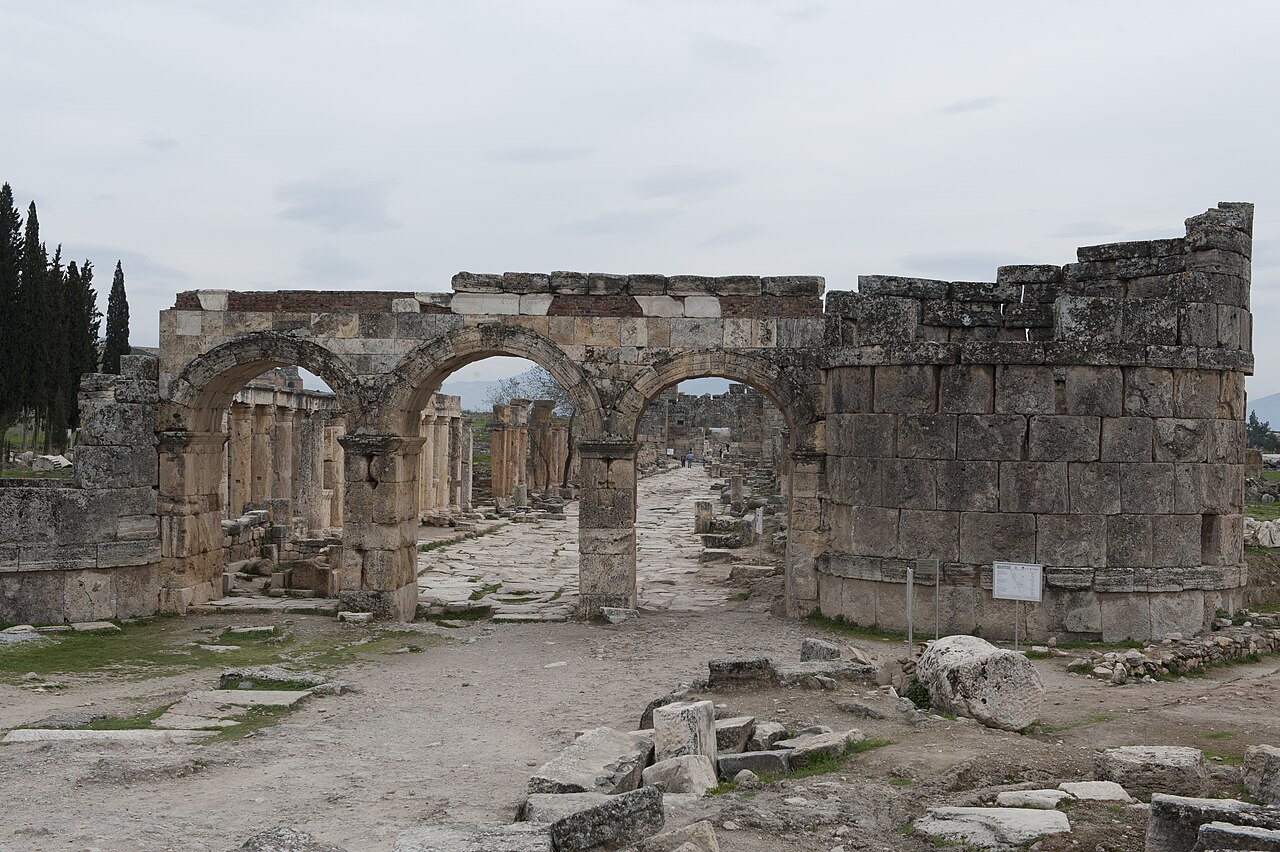
Most photographs of Pamukkale begin with the white terraces. The ancient city above them offers a different first impression: a monumental gateway opening onto a long urban street. At the northern side of Hierapolis, the gate often called the Frontinus or Domitian Gate invites you to imagine arrival, movement and public life, rather than treating the ruins as a collection of disconnected landmarks. Follow the street with your eyes and the city's plan begins to emerge.
A threshold between road and city
The gateway marks an approach to Hierapolis from the north. It did more than frame a picturesque view. Gates are places where a road becomes a city street, where the built environment announces that a visitor has entered a different space. Here, surviving arches and masonry still give the entrance a sense of scale. You do not need to reconstruct every missing stone to appreciate the effect: the opening directs attention forward, toward the street and the city beyond.
UNESCO refers to the Domitian Gate when describing conservation work at Hierapolis-Pamukkale; the monument is also widely identified as the Frontinus Gate. Names on maps and signs may vary, so use the location and the street alignment as well as the label when finding it. The two names should not be mistaken for two separate stops on the same walk.
Why the street matters
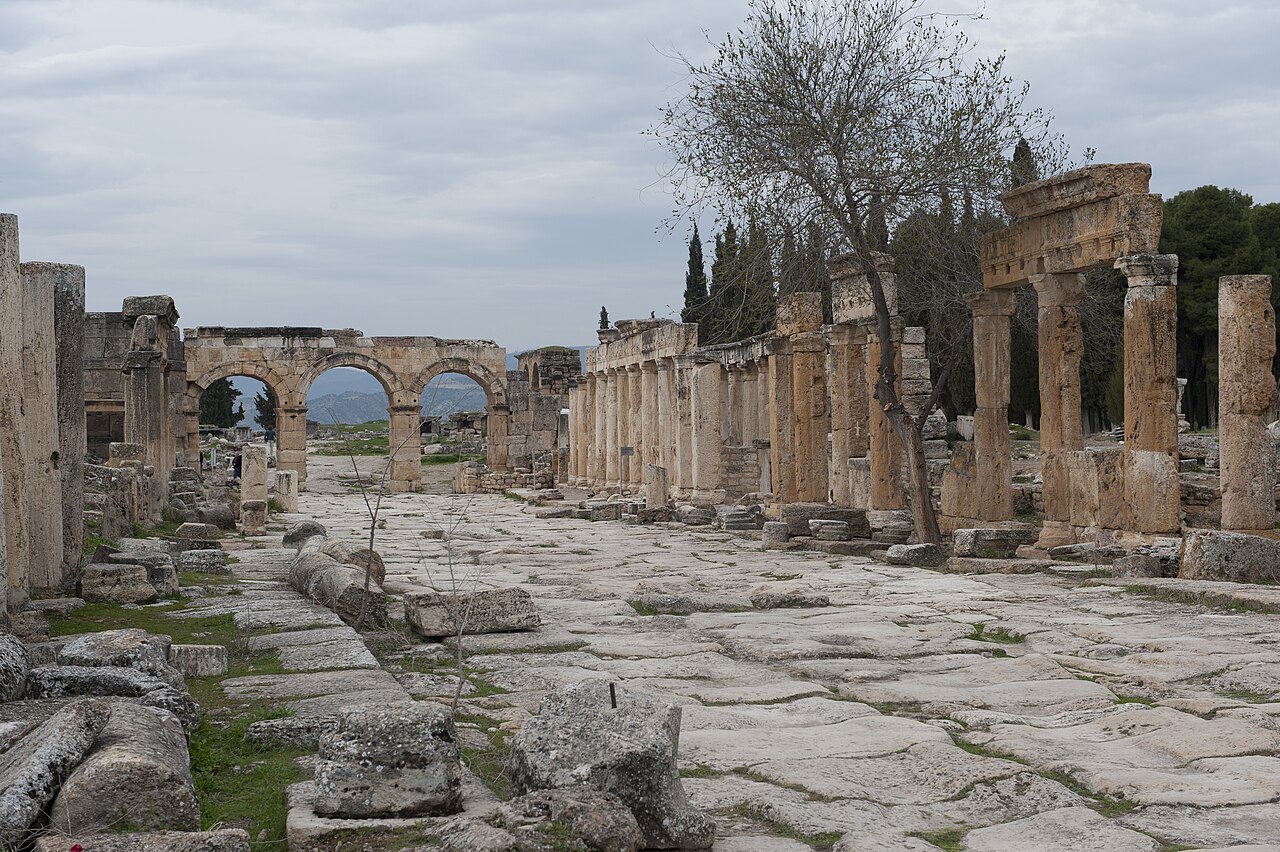
Türkiye's museum service describes the main street of Hierapolis as approximately one kilometre long, dividing the settlement into two parts. It also notes porticoes, public buildings, shops and workshops along the route. That description helps turn a line of paving stones into a social place. People used streets to cross town, but they also encountered commerce, civic activity and one another along their edges.
Look beyond the central walking surface. The street's width and direction are only part of the evidence. Where were the covered edges? How would a person have moved from the roadway to a shop or another public space? Some structures survive only as low traces, while others are easier to recognize. The gaps are important too: an archaeological street is not a complete stage set, and modern imagination should not quietly fill every absence with certainty.
After the earthquake of AD 60, the city developed a Roman grid plan, according to the official museum description. The street belongs to that broader urban story. It is useful to picture it as an organizing route, not as a single monument with one fixed viewpoint. Walk part of its length and then turn around. The gateway changes from destination to point of departure; buildings that seemed isolated begin to fall into relation with the route.
Read Hierapolis as a connected landscape
The gate is especially rewarding when paired with the burial area outside the city. Ancient tombs along the approach show that the transition into Hierapolis began before the masonry entrance. Our walk through the northern necropolis looks more closely at those monuments and the different ways people marked memory beside the roads. Seeing the cemetery first gives the gate an additional role: it becomes the point at which a route bordered by memorials turns toward daily urban life.
UNESCO treats Hierapolis and Pamukkale as one World Heritage property with both cultural and natural significance. The mineral springs and travertine formations are not merely a scenic backdrop to the city. They helped shape the place in which the settlement grew. From the gate and street, the terraces may feel some distance away, but the two belong to the same visit. The contrast between structured masonry and the flowing white landscape is part of what makes this site unusual.
Another useful comparison is the theatre. The street organized movement through the city, while the theatre gathered people in one place. Read our Hierapolis theatre article before or after a walk to see how a public building fits into the larger city. Neither stop tells the entire story on its own. Together with the gate, they let you ask how an ancient visitor arrived, moved, assembled and left.
What to notice on site
Begin with a wide view of the gateway rather than immediately photographing a decorative detail. Find the alignment of the street behind it. Then move closer and observe the scale of the openings and the joints between surviving blocks. Do not assume that every visible course stands exactly as it did in antiquity. Hierapolis has undergone excavation and conservation; the official interpretation at the site is the best guide to what has been restored.
On the street, pause at a point where its edges are readable. Notice changes in the ground surface, building lines and entrances. Imagine the experience of walking under a portico, but distinguish that interpretation from what remains physically visible. A few minutes of looking from several angles usually offers more than a hurried walk through the centre of the road.
Keep your route flexible. Archaeological sites may close individual areas for research, maintenance or visitor safety. Stay on permitted paths and avoid climbing the gate or fragile walls for photographs. The paving and open ground can be uneven; comfortable shoes, water and sun protection make a slow exploration easier. If mobility is a concern, ask the site staff about the currently accessible approach before planning a long walk.
Plan the gate into a Pamukkale day
A practical visit does not have to cover every surviving structure. Choose a sequence that makes sense for your available time: perhaps the northern approach and gate, a stretch of the main street, then one or two public monuments and the terraces. Allow room to stop and read the setting. Trying to collect only famous views can make Hierapolis feel smaller than it is.
Check the official museum listing shortly before travel for current access, admission and opening information. This article does not quote a price or a closing time because those details can change. If you prefer a guided visit, review our private Pamukkale and Hierapolis tour and ask whether the northern gate and street can be included in the written itinerary. The published tour starting price has its own stated inclusions and exclusions; site admission is separate.
The Frontinus Gate is more than a photogenic arch, and the street is more than a path to the next landmark. Together they reveal an ancient city designed for arrival and everyday movement. Give them time, and the better-known terraces become part of a richer, more legible landscape.
Sources and further reading
Explore Pamukkale with context.
Review the route and inclusions before requesting your own private itinerary.
EXPLORE THE PAMUKKALE TOUR