
Pamukkale's white travertine terraces are instantly recognizable, but they are only part of the World Heritage landscape. Beyond the ancient city of Hierapolis, tombs stretch along the roads that once led into town. A walk through the northern necropolis changes the pace of a visit. Instead of looking for one celebrated monument, you begin to notice how many generations chose to remember their dead in stone, and how a city announced itself to people arriving from outside its walls.
Why are there so many tombs at Hierapolis?
The word necropolis means a burial area rather than a single building. Türkiye's museum service describes burial grounds outside the city walls to the north, south and east, and calls the combined areas among the largest in southwestern Anatolia. The Denizli Provincial Directorate of Culture and Tourism places dense groups of tombs beside the northern road toward Tripolis and Sardis and the southern route toward Laodicea and Colossae. Their positions are a reminder that visitors to an ancient city might encounter memorials before its gates.
UNESCO gives the northern necropolis a particular place in the Hierapolis-Pamukkale World Heritage property. It describes a burial landscape extending for more than two kilometres and valuable for understanding Greco-Roman funerary practices. That scale is easy to miss if you see only one roadside sarcophagus before turning back to the terraces. The cemetery is not an isolated attraction: it belongs to the same settlement that had baths, temples, a theatre and later Christian buildings.
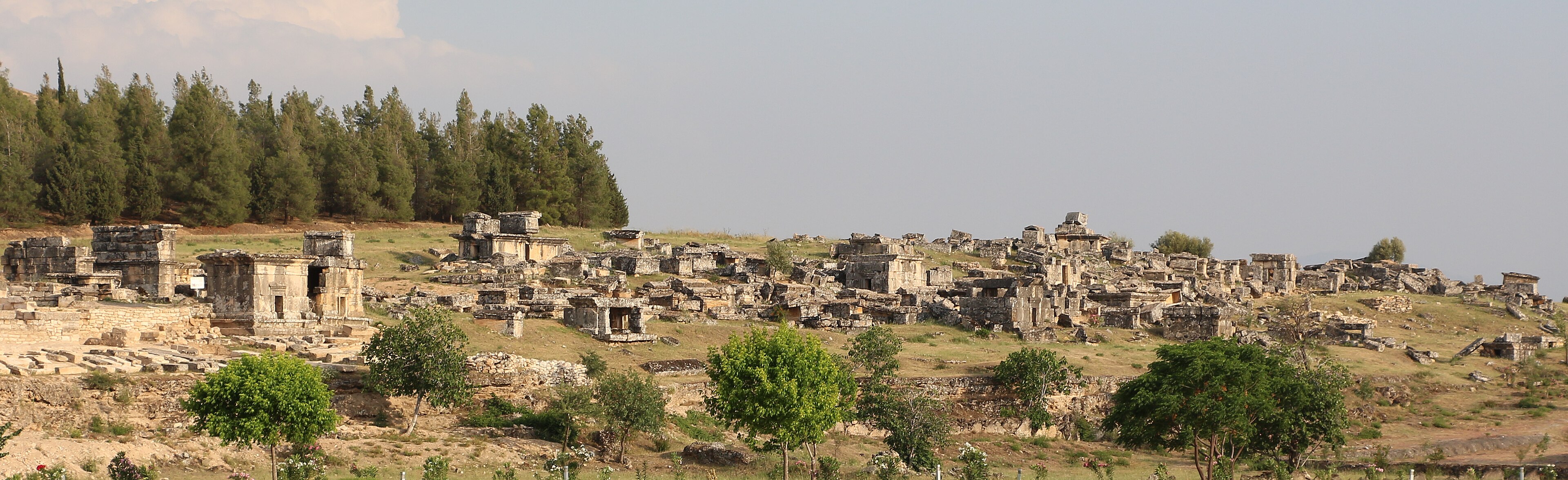
Read the different shapes before reading the labels
The tombs are not all the same. Denizli's official site names sarcophagi, tumuli and house-shaped tombs among the forms at Hierapolis. A sarcophagus is a stone coffin, often substantial enough to stand out even when its original setting has changed. A tumulus is a burial mound. Other monuments recall small buildings, with architectural details that imitate domestic or civic construction. The northern area preserves examples across a long span, from the late Hellenistic period into the early Christian era.
Look first at silhouette and construction. Does the tomb stand alone, sit on a base or form part of a larger built chamber? Does its roof resemble a house, or does a mound conceal much of the structure? Notice the relationship to the road and to nearby graves. This keeps a visitor from treating every stone box as the same kind of memorial.
The local directorate notes limestone and marble in the tombs, with marble especially associated with sarcophagi. Some monuments have lost parts, inscriptions or their original surroundings. Avoid assigning a name, profession or exact century to a particular tomb from appearance alone; rely on on-site interpretation where available.
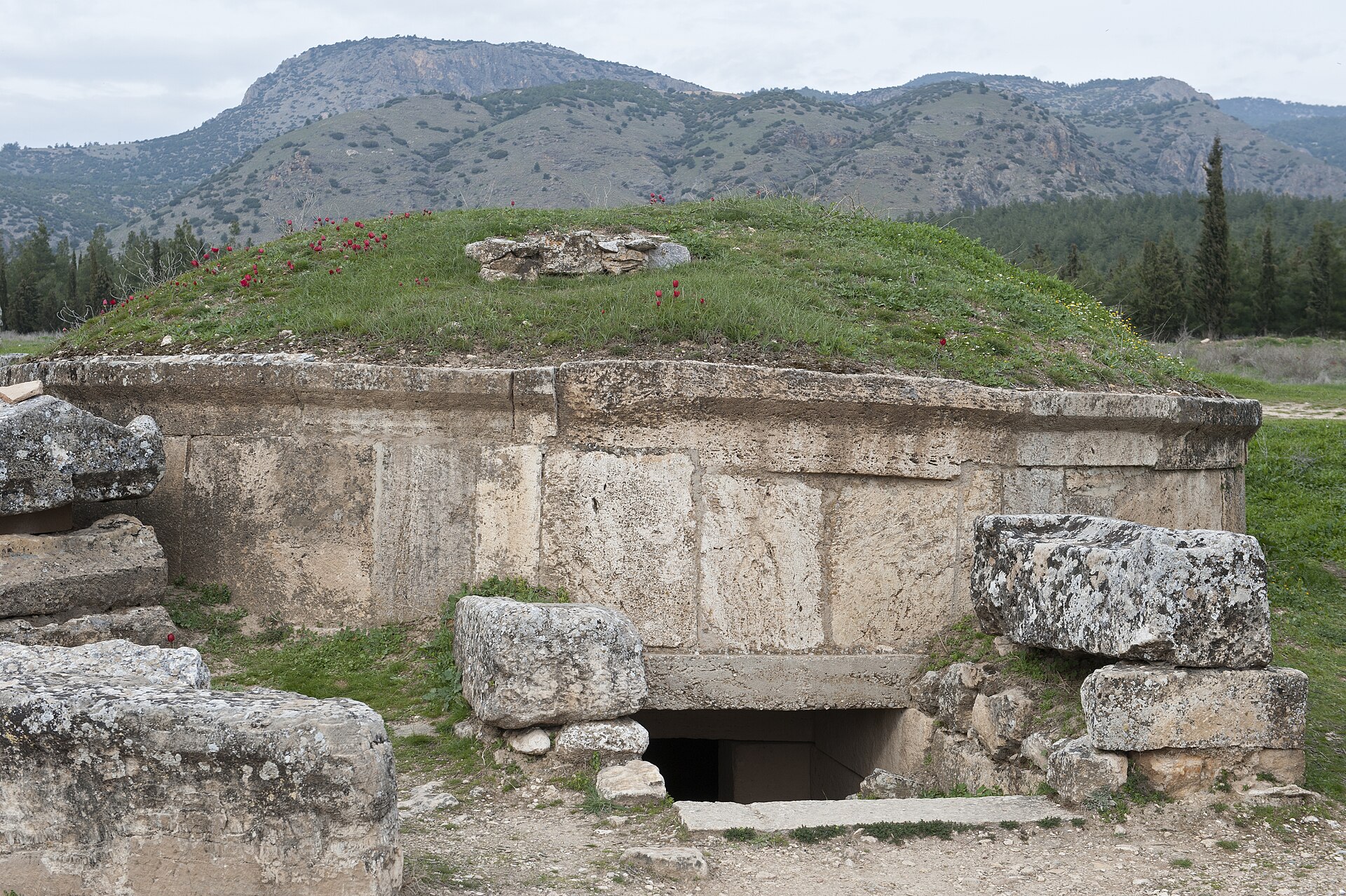
A tumulus up close
A mound can initially look like a natural rise among the stones. The form becomes clearer when you see its built edge and entrance. It asks a different kind of attention from a decorated sarcophagus: the architecture is partly hidden, and the earth itself contributes to the memorial's profile. At Hierapolis, that contrast between low mounds and upright stone monuments is one reason the northern necropolis rewards a slow walk rather than a quick photograph from a vehicle.
How the cemetery connects to the living city
It is tempting to divide a Pamukkale visit into separate boxes: terraces for nature, theatre for architecture and necropolis for funerary history. UNESCO's account makes a stronger case for reading them together. Mineral-rich springs helped shape the setting of a spa town; roads connected Hierapolis with the wider region; the city's public monuments and burial places developed across successive periods. The necropolis shows the outer edge of that urban story rather than an unrelated appendix.
UNESCO also mentions restored mausoleums and Tripolis Street in the north necropolis. Restoration can help visitors understand the layout, but it should not be mistaken for proof that every visible stone is in its untouched ancient position. Read conservation signs where they are provided. A thoughtful visit allows the landscape to be both archaeological evidence and a place still being studied and cared for.
If you have already visited the theatre, compare the experience. The theatre concentrates attention on a shared civic space, whereas the burial grounds spread individual memorials across a long approach. Our guide to the theatre of Hierapolis explains the public monument in more detail. Considering the two together gives a fuller picture of the ancient city than either stop alone.
Plan a respectful walk
Check the current museum information and the signs at your chosen entrance before setting out. Access routes and conservation barriers can change; this article does not assume that every tomb or path is open. The northern burial area covers more ground than a single viewpoint, so decide in advance whether your day allows for an extended walk. Build in time for the terraces and whichever city monuments matter most to you, rather than trying to cover every feature at speed.
Stone and earth surfaces can be uneven, and the route may be exposed to sun. Wear suitable shoes, carry water and allow pauses. Stay on permitted paths, do not enter closed structures and avoid climbing on ancient masonry for photographs. The best picture is often a wide view that shows how several tombs relate to the road and the hillside.
Confirm current admission and opening arrangements with the official museum service shortly before travel; they are not fixed in this article. If you are considering a guided day, our private Pamukkale and Hierapolis tour gives the published route and service scope. Ask whether time in the northern necropolis can be included in your written itinerary. Site admission and any optional facilities are separate from the listed tour starting price.
More than a detour
The necropolis can be quieter in tone than the terraces or theatre, yet it is one of the strongest reminders that Hierapolis was a lived-in city with roads, families and long memories. From the sweep of the burial landscape to a single mound or house-shaped tomb, the details reward patient looking. Leave room for that slower encounter and Pamukkale becomes more than its most famous photograph.
Sources and further reading
Explore Pamukkale with context.
Review the route and inclusions before requesting your own private itinerary.
EXPLORE THE PAMUKKALE TOUR