
Pamukkale's white terraces command attention, yet the ancient city above them has another landscape to explore. Beyond Hierapolis's busy central route, the sanctuary associated with St Philip occupies a hill with views back across the ruins. Its surviving walls ask visitors to think about a different kind of journey: the movement of pilgrims through a city already famous for its springs. The Martyrium is rewarding precisely because it does not look like a complete church. Its plan, position and fragments leave room for careful observation.
Why the sanctuary belongs to the Hierapolis story
UNESCO describes Hierapolis-Pamukkale as a place where natural thermal formations and a long-lived city developed together. Roman baths, streets and monuments remain part of that story, but the site also preserves an important group of early Christian buildings. UNESCO identifies the Martyrium of St Philip as the most significant of those monuments. It stands outside the city's north-western wall, above a monumental approach. The location matters: reaching it means leaving the familiar sequence of terraces and central ruins and recognizing that later worshippers read the same landscape in a new way.
The sanctuary commemorates Philip, a figure linked to Hierapolis by Christian tradition. The tradition and the building's dedication are historically important even when details of Philip's life and death cannot be verified with the certainty of a modern record. A responsible visit separates the surviving architecture from the stories that gave it meaning. You can study the masonry and the outline of the complex while understanding why generations of pilgrims came here.
Read the octagon before imagining the lost building
From the ground, look for the organizing shape rather than expecting a standing dome. UNESCO's description explains that the central octagon was surrounded by chapels and other rooms, producing a much larger composition than one circular chamber. The Denizli Provincial Directorate of Culture and Tourism dates the hilltop octagonal church to the early fifth century. It also describes spaces around the main structure that accommodated the sanctuary's religious life. What remains today is a pattern of stone foundations, walls and openings, not a finished interior preserved in one moment of time.
Try moving your eye from the center outward. Where do the doorways seem to direct movement? How do the rectangular and angled spaces change the rhythm of the plan? The exercise is more useful than assigning a confident function to every fragment. The precise use of individual rooms may depend on excavation and interpretation. A site panel or current archaeological publication should take priority over any quick description written from a photograph.
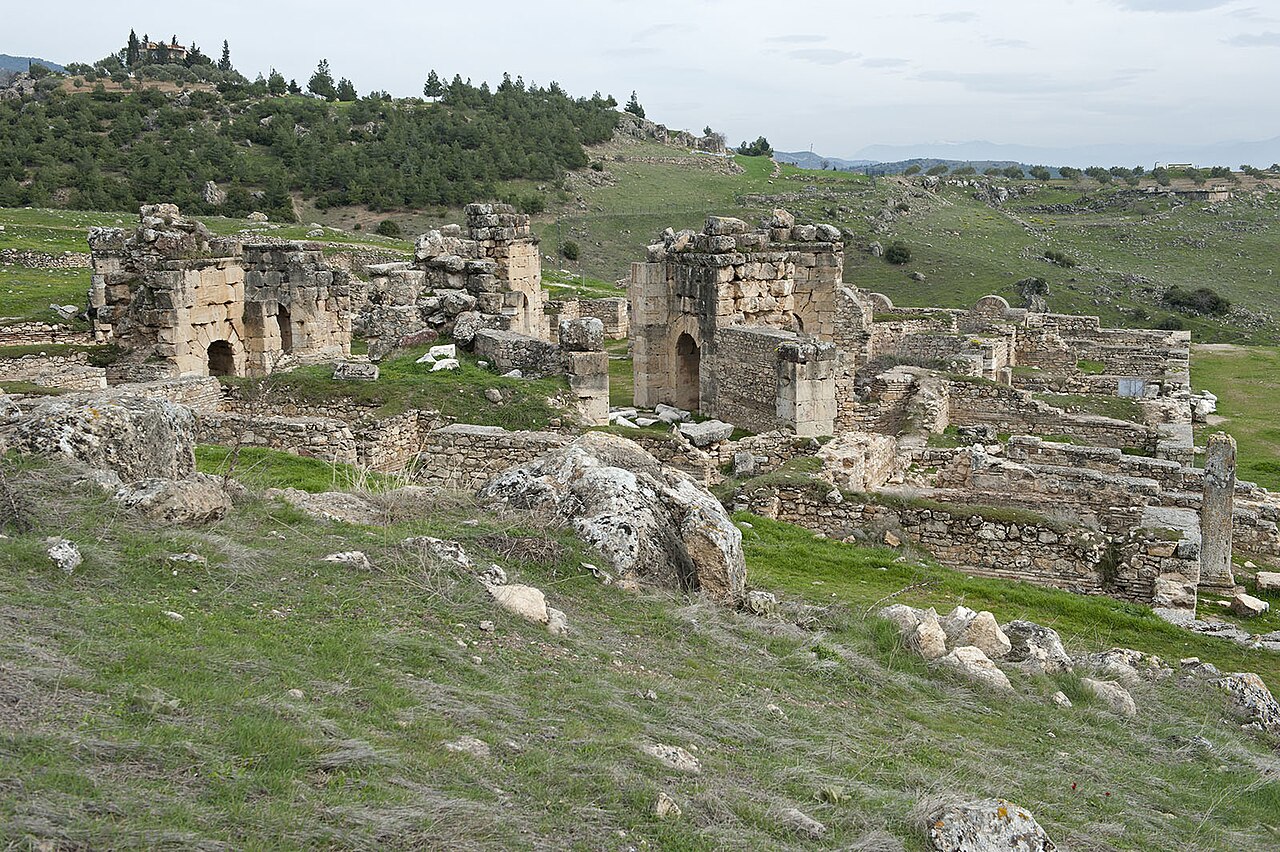
A route shaped by pilgrimage
The climb is part of the historical setting, not merely the way to a viewpoint. UNESCO notes the monumental stairway leading toward the Martyrium. Research by the Italian Archaeological Mission at Hierapolis has examined an ancient pilgrimage route and structures associated with it, including a water feature and a church. Together they suggest an experience organized through movement, arrival and ritual. You need not reconstruct every ceremony to appreciate how different this is from simply entering a building from a street.
Hierapolis was already a place strongly associated with water. UNESCO explains that thermal installations and religious practices formed part of its ancient identity. The Christian sanctuary belongs to a later chapter, so avoid folding every pool and spring into a single unchanging tradition. Instead, notice how a city can acquire new meanings while still using the same terrain. The hill, the approach and the wider ruins help make that long sequence visible.
What archaeology adds to the tradition
Descriptions of the sanctuary do not all tell the tomb story in the same way. Older summaries sometimes locate Philip's tomb at the center of the octagonal Martyrium. Excavations on the hill, however, have identified a separate church and a Roman-period funerary structure along the pilgrimage route. The Italian mission's published research discusses this complex as part of the sanctuary of St Philip. It is best to describe the structures and the interpretation without claiming that a particular grave can be proved to belong to the apostle.
This distinction makes the site more interesting, not less. Archaeology can establish plans, phases, materials and evidence of commemoration. It cannot, by itself, settle every question raised by religious memory. When reading a sign or guidebook, ask whether it is describing a physical find, a late antique belief or a modern interpretation of both. That simple question helps you appreciate the place without flattening its history into a single certainty.
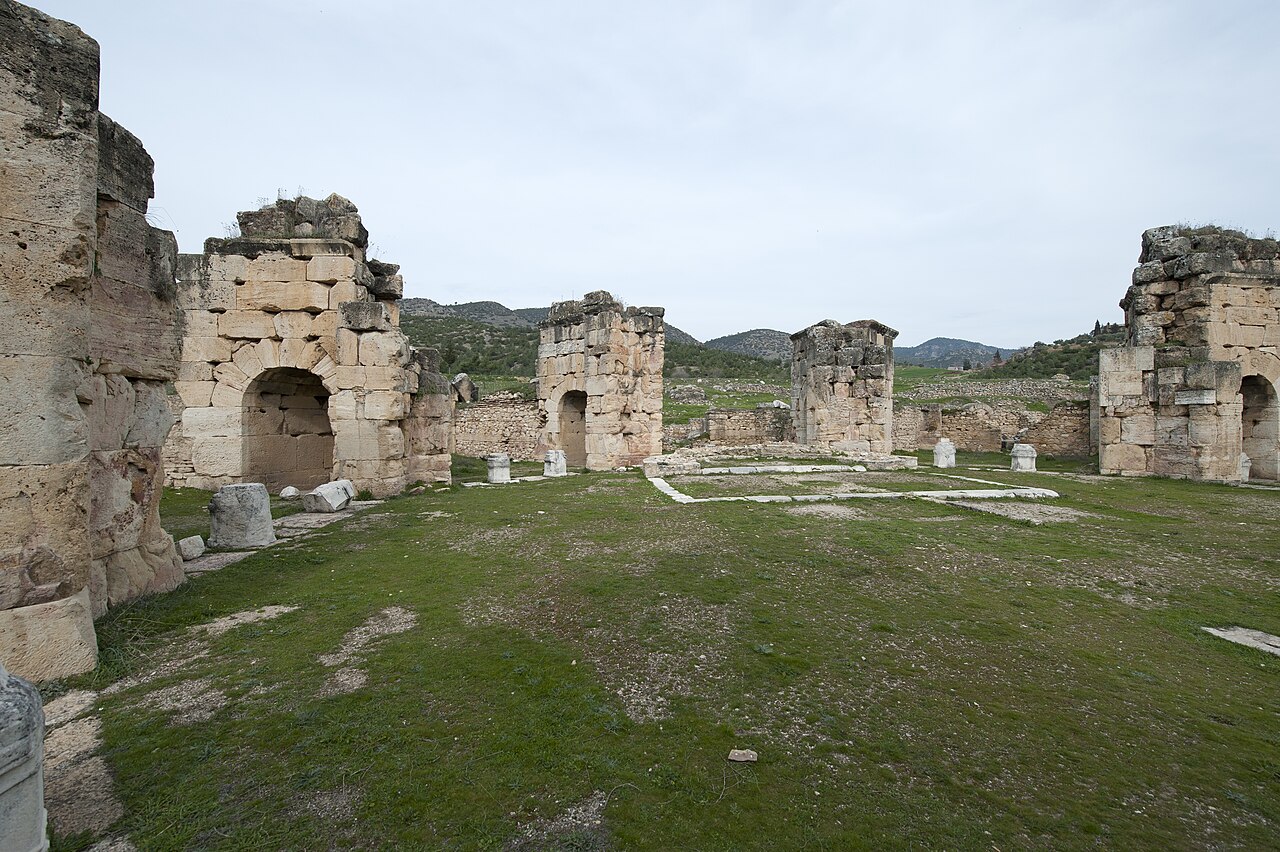
Plan a thoughtful stop
Allow time to reach the hill and to look back over the city, rather than treating the Martyrium as a quick photograph. The ground can be uneven and the route exposed, so sturdy shoes, water and weather-appropriate protection make the visit easier. Follow marked paths and barriers; archaeological areas can change during conservation. If mobility is a concern, ask the site about current access before travelling instead of relying on an older description of the stairs or paths.
Before your visit, check the official Hierapolis-Pamukkale site listing for current admission and access information. This article does not assume that every part of the hill is open on every day, or that a particular ticket or tour includes the sanctuary. Interpretive panels and on-site staff are the best guides to any route changes.
Connect the hill with the city below
The Martyrium is most memorable when visited as one chapter of Hierapolis rather than as an isolated religious monument. Compare its hilltop position with the more public scale of the Hierapolis theatre. Then consider the Frontinus Gate and colonnaded street, where the city's movement and civic display took another form. These stops do not all belong to the same period. Their value together is that they show how the place changed while its roads, slopes and springs continued to shape experience.
Our private Pamukkale and Hierapolis tour is a starting point for planning a guided day. The published route does not promise a Martyrium stop; request it when discussing your itinerary and confirm access, timing and any admission arrangements in writing. That gives this quieter part of the archaeological landscape the attention it deserves.
Sources and further reading
Explore Pamukkale with context.
Review the route and inclusions before requesting your own private itinerary.
EXPLORE THE PAMUKKALE TOUR