
Pamukkale’s white terraces can make Hierapolis seem like a city defined entirely by thermal water. Walk along its ancient street, however, and a different kind of water architecture comes into view. The Nymphaeum of the Tritons was a monumental fountain designed for public display. Its long basin and surviving masonry ask visitors to imagine water, sculpture and movement together. Today it is a place to pause rather than a complete façade to admire. That incomplete state makes it especially rewarding to read carefully.
Find the fountain in the city, not only in a photograph
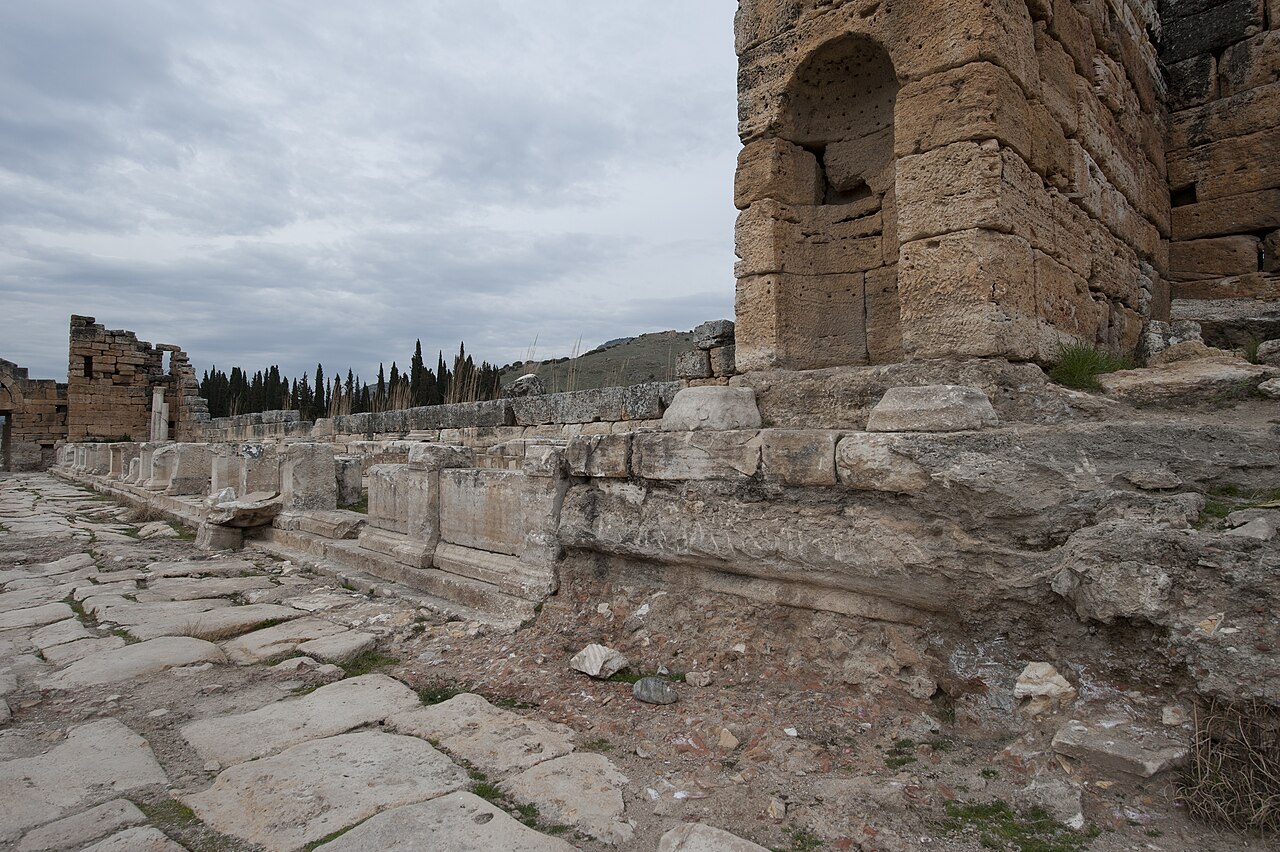
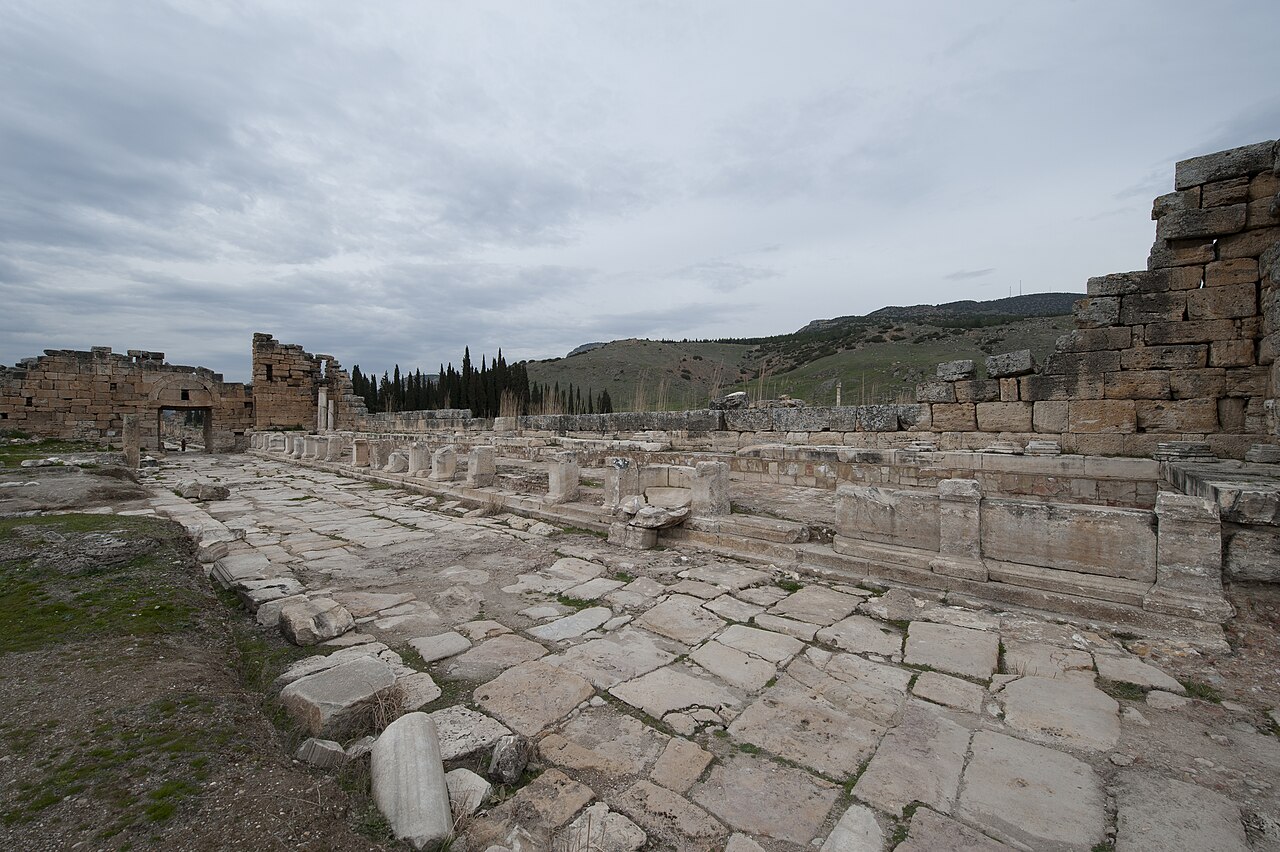
The Turkish Ministry of Culture and Tourism identifies the Triton Fountain as one of Hierapolis’s two large monumental fountain buildings. Its account places a long basin along the street and describes curved ends with niches intended for statues. The surviving stones are therefore part of a street-facing composition, not an isolated pool. Stand back where the visitor route allows and follow the line of the basin with your eyes. Then look at the relationship between that line and the paved street. The fountain was made to be seen by people moving through the city.
This is a useful correction to the familiar image of Pamukkale as only a landscape of white water and limestone. UNESCO recognizes Hierapolis-Pamukkale as a combined natural and cultural property. The travertines and the ancient city belong to one setting, but they tell different stories. Water shaped the natural formations, while people also channelled it, framed it and gave it a public architectural role. The nymphaeum helps make that human choice visible without claiming that the surviving basin works as it once did.
What the carved decoration reveals
The name “Tritons” comes from the marine figures associated with the fountain’s decoration. The ministry describes sculptural fragments recovered during systematic excavations begun in 1993. Among the finds were reliefs of an Amazonomachy, a mythical battle involving Amazons, and personifications of rivers and springs. These subjects linked the monument to a wider language of myth and water. A visitor should not expect every fragment to remain in its original position on the exposed structure. Archaeology reconstructs a building from material that has fallen, shifted or been conserved.
That distinction matters when looking at a ruin. The modest walls and basin visible today can feel unlike the grand object implied by the word “monumental.” Think of the missing vertical layers: architectural members, sculpted panels, niches and statues. The ministry notes that blocks fell into the large basin and acquired a thick calcareous covering. This history of collapse and burial explains why excavation could recover decorative elements while the standing façade remains partial. The display on site records a sequence of building, damage, discovery and conservation, not a frozen Roman moment.
According to the ministry, architectural style and an inscription dedicated to Emperor Alexander Severus date the complex to the first half of the third century CE. This is a stronger basis for dating than guessing from the colour of a stone or the apparent age of a wall. Read the period as a context for the fountain’s public ambition, while remembering that later earthquakes and reuse changed what survived. If an interpretation panel offers a more detailed reconstruction, compare it with the actual masonry rather than assuming the drawn elevation is still standing.
Follow water beyond the fountain
The ministry’s Hierapolis account also describes aqueduct channels bringing drinking water from surrounding hills and a distribution network leading into city streets and houses. The Nymphaeum of the Tritons should not be reduced to a piece of plumbing, yet its display made sense within a city that had to move and manage water. The contrast between a practical supply system and a richly decorated public basin is worth holding in mind. One served daily needs; the other also gave water a civic and visual presence.
For a second perspective, compare this fountain with the sanctuary near the Temple of Apollo, where the ministry places another monumental fountain. Do not merge the two sites into one stop or attribute a photographed detail to the wrong building. Hierapolis covers a broad area, and small changes in orientation can make ruins look similar. Use the official site map and the signs beside each structure. An unhurried comparison of setting, scale and surviving fabric is more useful than a hurried checklist of names.
The nearby Frontinus Gate and colonnaded street provide another way to read movement through the city. A gate frames arrival; a street organizes passage; the fountain gives that passage a designed visual stop. This is an interpretive connection rather than a promise of a fixed walking route. Access can shift during conservation, and the sensible path on the day may differ from a route described in an older guide.
Visit with the site as it is today
Before travelling, consult the official Hierapolis-Pamukkale visitor information for current access, ticketing and any conservation notices. We do not quote a price or opening time here because these can change. On site, stay on marked paths and do not climb on the basin or loose architectural blocks. The exposed ancient streets can be uneven, so supportive footwear and water help when walking between monuments. Give yourself time to look from more than one permitted angle; the long outline is easier to understand from a little distance.
A good short exercise is to photograph the whole basin first, then one detail that explains the building’s former use or decoration. Caption each image with the actual monument name. If you continue toward the Pamukkale travertines, notice how different the natural pools feel from a designed urban fountain. Both depend on water, but they should not be treated as the same historical feature. That distinction makes the combined UNESCO landscape richer rather than more complicated.
If you would like to include Hierapolis in a private day, explore the Pamukkale and Hierapolis tour and confirm the route and any requested monument stops before booking. The Nymphaeum of the Tritons is a compact lesson in the life of this city: public display, mythic imagery, engineered water, earthquake damage and modern archaeological care all meet in one long line of stone beside the street.
Sources and further reading
Explore Pamukkale / Hierapolis with context.
Review the route and inclusions before requesting your own private itinerary.
EXPLORE THE PAMUKKALE TOUR