
Above Pamukkale's white terraces, the ancient city of Hierapolis preserves a sanctuary that is easy to pass without understanding. The Temple of Apollo survives as low walls, steps, columns and scattered blocks, rather than the complete façade many travellers expect from a classical temple. Its setting is the key. The sanctuary stood on ground shaped by the same geological forces that fed the thermal landscape below. A visit here offers a way to connect religion, city planning and geology without treating the ruins as a single dramatic photograph.
Begin with the ground, not a reconstruction
UNESCO's account of Hierapolis-Pamukkale places the Temple of Apollo on a geological fault from which harmful vapours escaped. That is a striking fact, but it needs careful interpretation. It does not mean that every stone visible today dates from one building phase, or that visitors should seek out a gas opening. It means that the natural character of this ground mattered to people who built and used the sanctuary. The wider World Heritage property combines a mineral-water landscape with a long-lived city; the temple is one place where those stories meet most clearly.
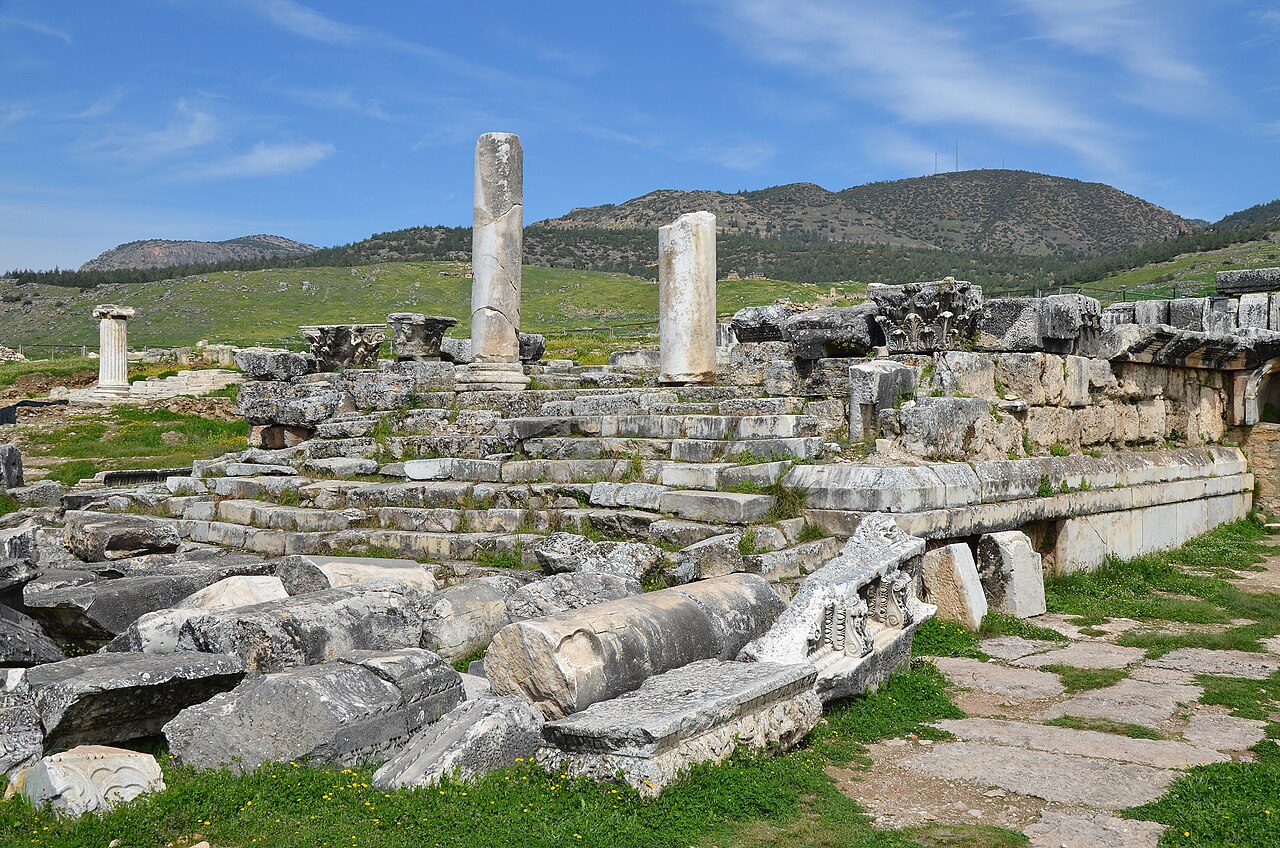
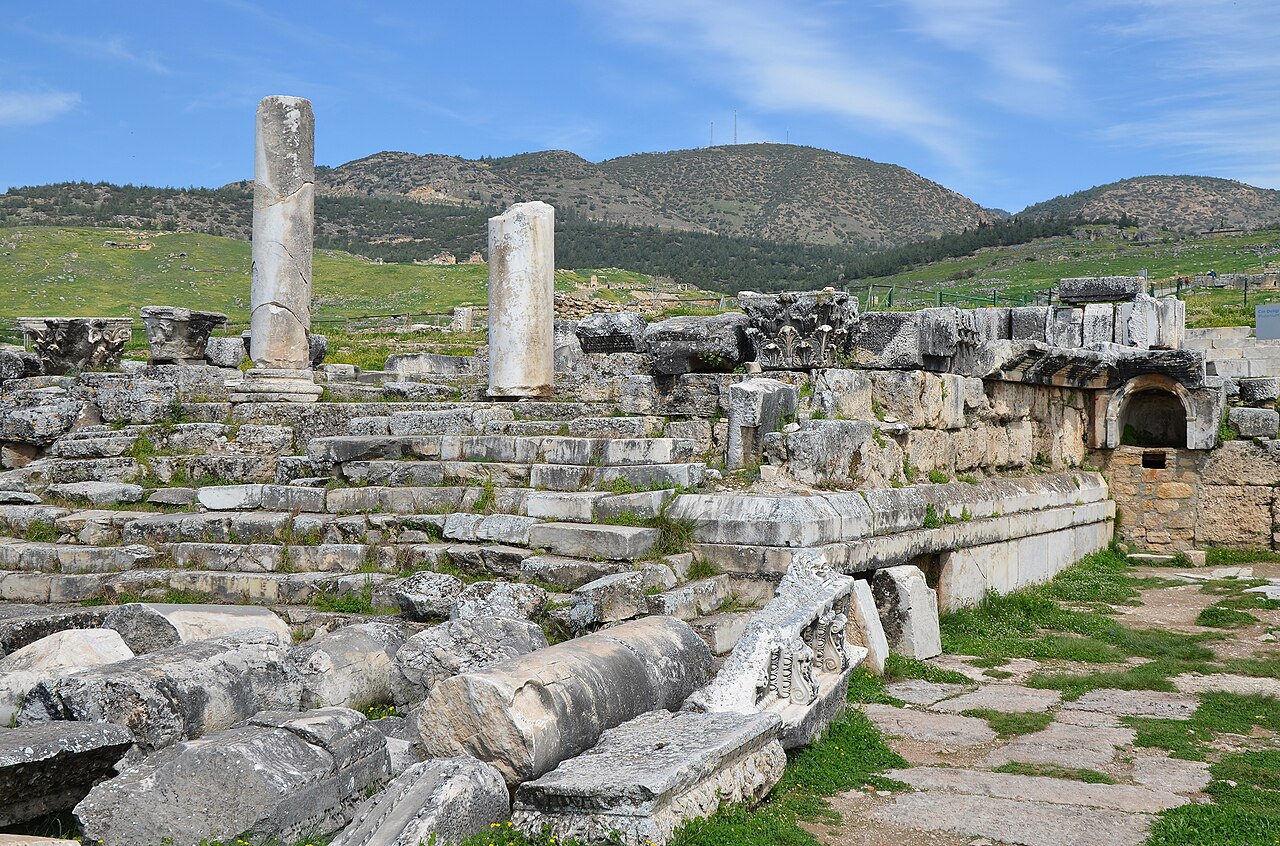
Stand at a permitted viewing point and look across the remains before focusing on a single capital or column. The steps establish a change of level. Broken architectural pieces suggest a structure that has been damaged, altered and studied over time. The hills behind the site keep the building tied to its setting. A photograph can flatten all this into a row of stones; walking the edge of the sanctuary, where access allows, reveals why its location mattered.
What the surviving stones can tell you
The official Turkish museum listing identifies the Temple of Apollo among the principal monuments of Hierapolis, alongside the theatre, Ploutonion, baths, water channels and churches. That list is a useful reminder that the sanctuary was part of a city with many functions. People moved between civic spaces, places of worship, water infrastructure and burial grounds. The temple should not be imagined as isolated on an empty hillside simply because the standing walls are now incomplete.
The ancient building changed through time. The Wikimedia Commons record for the photograph above describes a third-century building made with blocks from an older temple. That caption is helpful context, though individual phases are best understood through archaeological publications and on-site interpretation rather than through an image alone. When looking at the ruins, distinguish what is directly visible—the steps, masonry and fragments—from a reconstructed roofline that exists only in an illustration. The modest remains can still communicate scale if you compare them with the human path beside them.
Look also at carved pieces lying near the platform. A capital, moulding or shaft fragment records the work of stonecutters and the later events that separated it from its original position. The apparent disorder is part of the site's history. It may include collapse, reuse, excavation and conservation. Resist the temptation to move a small fragment for a clearer photograph. The context in which an object lies can matter as much as its decoration.
Understand the relationship with the Ploutonion
Nearby, the Ploutonion was linked in ancient accounts with a fissure and dangerous vapours. UNESCO specifically notes the fault beneath the Apollo sanctuary. The two places belong to a connected sacred landscape, but they are not interchangeable names for the same surviving structure. Read them together: the temple shows the architectural expression of a cult place, while the Ploutonion directs attention to the natural feature and beliefs associated with it. Avoid treating the ancient “underworld” language as a modern description of a safe visitor attraction.
The distinction matters on the ground. A wide picture of the ruins may include features that belong to adjacent areas. A sign or barrier may clarify a boundary better than a travel photo taken years ago. Follow current paths and never approach a restricted opening to test an ancient story. The site is interesting precisely because people interpreted its geology; visitors do not need to repeat the risks that made it memorable.
Place the sanctuary in a wider Hierapolis walk
A useful route through Hierapolis combines different kinds of evidence. The Frontinus Gate and colonnaded street show an approach through the city. The theatre presents a public space built for an audience. The sanctuary asks you to notice a different relationship between architecture and terrain. The travertine terraces then make the action of mineral-rich water visible on a much larger scale. Seeing these together helps explain why UNESCO recognises both the natural and cultural qualities of Hierapolis-Pamukkale.
Do not attempt to cover every monument at a sprint. Distances can feel longer than they appear in photographs, and the exposed ground offers little shelter in some sections. A slow look at a few connected places will usually be more rewarding than a hurried circuit. Check the site's current route and any conservation closures when you arrive. An older map or image may show a viewpoint that is no longer open.
Practical notes before you go
Wear footwear suitable for uneven stone and bring water and sun protection appropriate to the season. If anyone in your group has limited mobility, ask about the current approach to the sanctuary before setting out; ancient surfaces and changing visitor paths can affect access. The official Hierapolis-Pamukkale museum listing is the place to check admission information and visiting arrangements close to your travel date. This article gives no fixed ticket price or opening hour because both can change.
If you are considering a private Pamukkale and Hierapolis tour, ask whether time at the Apollo sanctuary fits your itinerary. Confirm the final route and inclusions in writing. A guide can help connect the temple to the neighbouring sanctuary and terraces, but no photograph or blog article guarantees access to a particular viewpoint. Leave room in the day to pause, read the signs and compare what you see with the landscape around it.
The Temple of Apollo is compelling because its fragmentary condition asks for observation. Its steps and carved blocks speak of a built sacred place; the fault beneath it recalls the forces that shaped the city. Read both together and the ruins become more than a collection of stones.
Sources and further reading
Explore Pamukkale with context.
Review the route and inclusions before requesting your own private itinerary.
EXPLORE THE PAMUKKALE TOUR