
At Hierapolis, a building near the northern entrance tells two stories in the same stone. It began as a bath and later became a Christian basilica. The name Bath-Basilica is therefore a useful clue, not a reference to the large Roman bath that houses today's archaeology museum. Give this monument a few minutes before following the long street toward the centre of the ancient city: its arches invite a closer look at how Hierapolis changed.
Find the building by the northern approach
The Denizli Provincial Directorate of Culture and Tourism places the Bath-Basilica beside the Frontinus Gate. That location matters. The gate and the colonnaded Frontinus Street formed a prominent approach to Hierapolis; a substantial public building stood near the point where movement into the city began. Look for the surviving arches and broad masonry, then compare their position with the gate rather than treating the ruin as a solitary photo stop.
The ministry dates the bath to the third century CE. Its account also describes the building's later conversion into a three-aisled basilica after the fifth century. A visitor need not reconstruct every lost room to appreciate the change in use. The same site carried one function in the Roman city and another in the Christian city that followed. That sequence makes the Bath-Basilica a particularly clear place to think about continuity as well as alteration.
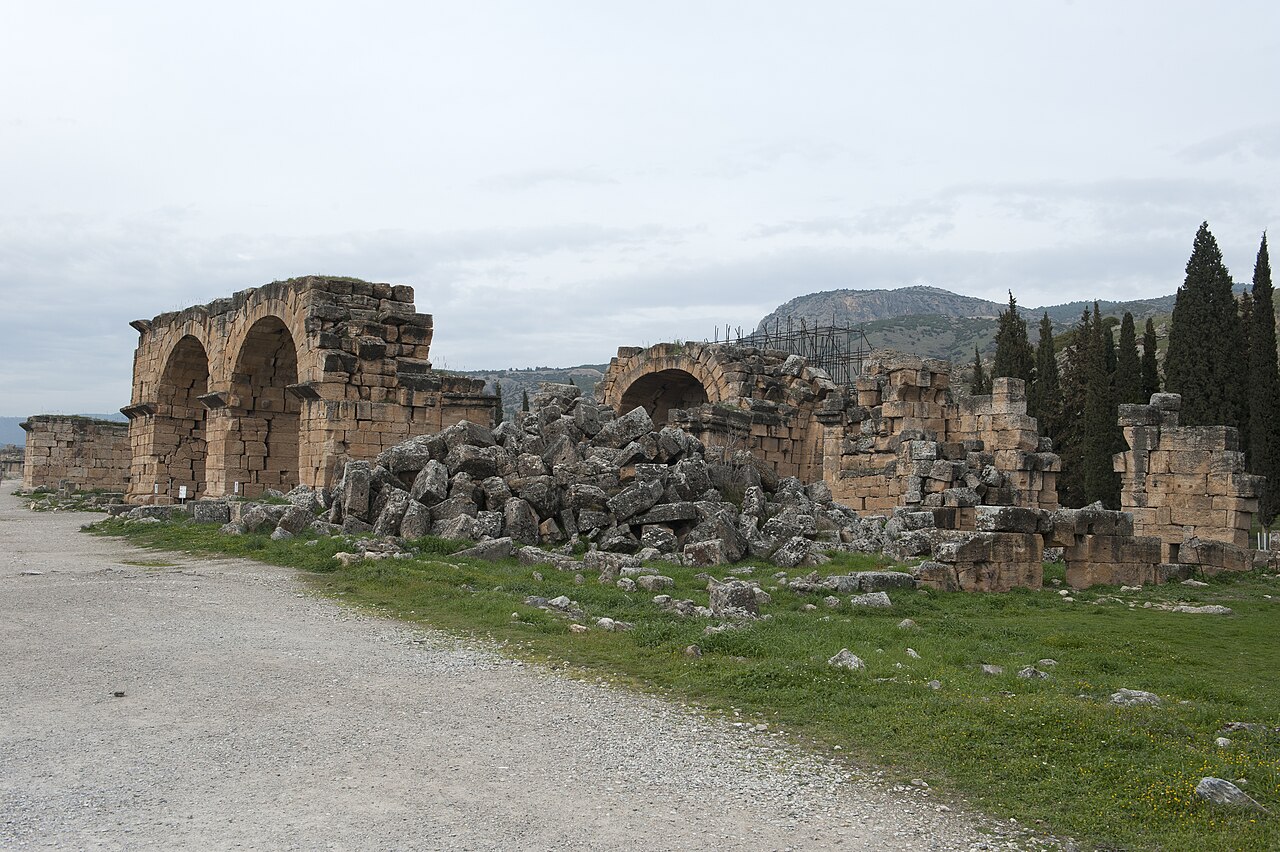
Approach from a permitted path and take in the whole exterior before moving closer. The wide view helps you distinguish the tall arches from the fallen blocks in front of them. In photographs, the surviving openings can look like an isolated gateway, but this was a building. Its remaining masonry is only part of a larger architectural arrangement, and conservation work can change which viewpoints are available on the day of your visit.
Read the change from bath to basilica
The provincial directorate gives a specific account of the transformation: a wall of the bath's caldarium, or hot room, was removed on the south side, and an apse was added. It describes the resulting basilica as having three aisles and says that the earlier barrel-vaulted arrangement gave way to three domes. These details are more informative than a vague claim that the building was simply “reused.” They describe deliberate changes to its plan and roof.
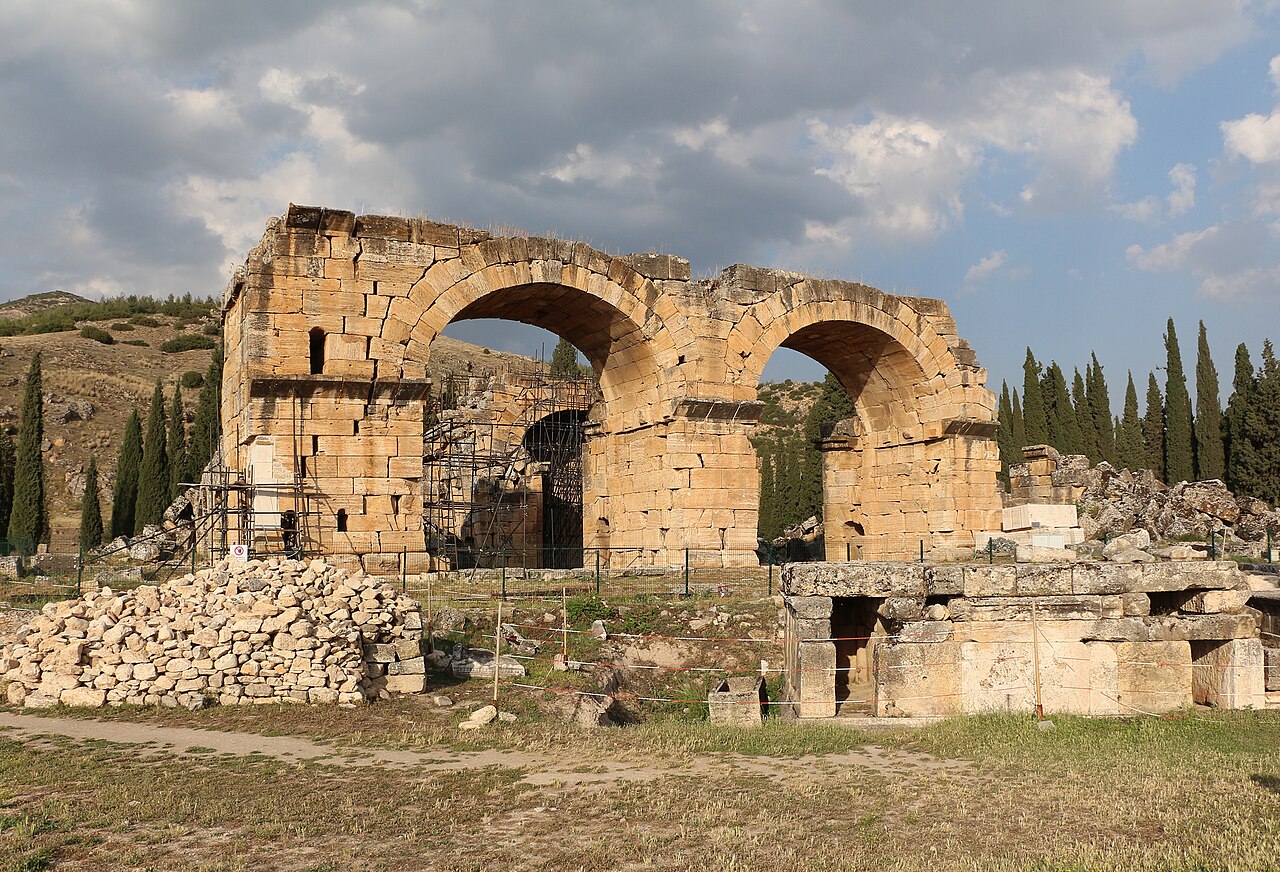
That does not mean every phase is equally legible from the path today. Earthquakes, collapse and later strengthening have all affected what remains. UNESCO's description of Hierapolis-Pamukkale specifically notes that the Bath-Basilica suffered earthquake damage and that its structure has been reinforced. A straight edge or an apparently complete arch should not automatically be assumed to be untouched ancient fabric. Read the conservation story alongside the Roman and Christian phases.
UNESCO also places Hierapolis's churches within a wider Early Christian architectural group. The Bath-Basilica offers one example of a building whose history crosses the transition between the city's Roman and Christian periods. To explore a different Christian monument, see our article on the Martyrium of St Philip. The two sites belong to the same historical landscape, but they had different plans and purposes; neither should be used as a stand-in for the other.
Compare it with the museum bath
Hierapolis has more than one major bath structure. The Denizli museum authority identifies the large Roman bath used by the Hierapolis Archaeology Museum as a different complex. Its galleries now display finds from Hierapolis and other cities of the Lycus Valley. The Bath-Basilica by the northern gate is not that museum. Keeping their locations and later uses separate makes a visit easier to understand.
This comparison reveals why a simple label such as “Roman bath” can be misleading on a map. One bath became a basilica; another eventually became a modern museum. The ruins also belong to different visitor experiences. At the Bath-Basilica, exterior walls and openings help you read a partly lost building in its setting. In the museum, objects and architectural fragments can be examined more closely within a curated display. Both views are useful, provided they are not confused.
Our article on the latrine beside Frontinus Street adds a third perspective on the city's practical buildings. Together these places show that Hierapolis was more than its terraces and theatre. It had facilities for movement, bathing, sanitation, worship and, much later, the preservation and display of its archaeological heritage. You can connect those functions without claiming that every surviving structure belonged to the same building phase.
Plan an attentive stop
Begin with the northern approach and identify the Bath-Basilica using current site signs or an official map. Then look at its arches from two permitted viewpoints. Notice the size of the stone blocks, the relationship between standing walls and fallen masonry, and the building's proximity to the gate. A contextual photograph will be more useful afterward than a close-up that hides where the structure stands.
Do not climb on loose blocks or enter a fenced area to reproduce a photograph. Archaeological surfaces are uneven, and conservation barriers may change. Allow enough time to walk at a comfortable pace, carry water and wear shoes suitable for stone paths. Check the site's official information shortly before travelling for access arrangements, ticket details and any temporary restrictions; older articles and photographs cannot establish today's conditions.
If you are planning a private Pamukkale and Hierapolis tour, ask which part of the ancient city the proposed route covers and whether the northern approach is included. A clear itinerary helps you decide how to balance the travertines, museum and ruins. The Bath-Basilica rewards visitors who want to see change over time in a single monument: a public bath adapted for worship, later damaged, conserved and interpreted as part of a protected landscape.
Sources and further reading
Explore Pamukkale / Hierapolis with context.
Review the route and inclusions before requesting your own private itinerary.
EXPLORE THE PAMUKKALE TOUR