
Pamukkale's white terraces command the first glance, but the ruins above them belong to a city with several histories. The Cathedral of Hierapolis belongs to its Christian chapter. UNESCO identifies a cathedral, baptistery and churches among the Early Christian monuments of the World Heritage site. Looking for this group in the ancient city's centre can make the visit feel less like a sequence of isolated ruins and more like a walk through a changing urban landscape.
Find the cathedral within the city
The Republic of Türkiye Ministry of Culture and Tourism places the cathedral in central Hierapolis, between the agora and the theatre, near the northern junction of the colonnaded street. That is a useful starting point on a site map. The building was part of the city rather than a remote sanctuary: visitors moving between civic spaces and streets would have encountered a Christian monumental complex within an older urban framework.
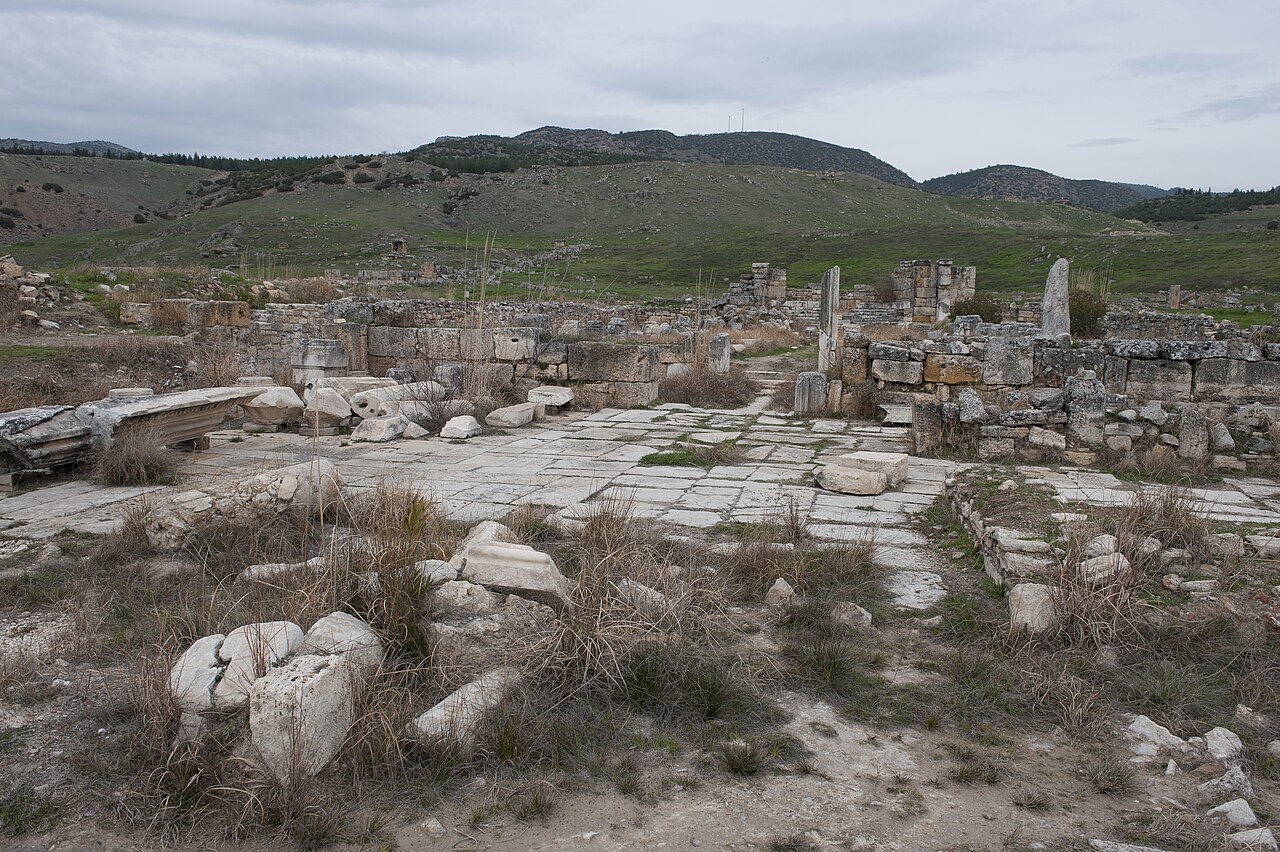
Use the colonnaded street as an orientation line, then locate the cathedral area against the agora and theatre. A modern path does not necessarily follow every ancient approach, so rely on current signs and permitted routes. The photograph below shows surviving masonry rather than a reconstructed church. The apparent gaps are part of the challenge of reading any archaeological site: a roof, doors and much of the original interior are no longer there to make the plan obvious.
Pause before moving into the ruins. Look for alignments of walls and spaces rather than searching for a single intact facade. An atrium, or courtyard, and a baptistery belonged to the wider cathedral complex, but their relationship is easier to understand with an official plan or a guide than with one close photograph. Ask which elements are securely identified and which have been altered or conserved since excavation.
Read a Christian city within a Roman one
UNESCO describes the Christian monuments at Hierapolis, built between the fourth and sixth centuries, as an outstanding Early Christian architectural group. It names the cathedral and baptistery alongside other churches. This description matters because the cathedral is not an isolated sign of a sudden change. It belongs to a wider period in which the city remained inhabited while its public spaces and religious priorities evolved.
The older city did not disappear from view. The theatre of Hierapolis, the streets and the agora still provide the framework for understanding where the cathedral stands. Looking from one monument toward another allows you to ask what changed in the way people gathered, moved and marked important places. It is a better question than trying to imagine that every structure visible today was in use at precisely the same moment.
UNESCO also explains that Hierapolis became an important religious centre in the Eastern Roman period. Its account singles out the hilltop Martyrium of St Philip as the most important monument of this Christian group. The cathedral is a different building, in a different part of the site. Our Martyrium article explains the octagonal sanctuary on the hill; keeping it distinct from the cathedral prevents a common confusion when reading a short map legend or a travel photograph.
Notice the baptistery and the wider complex
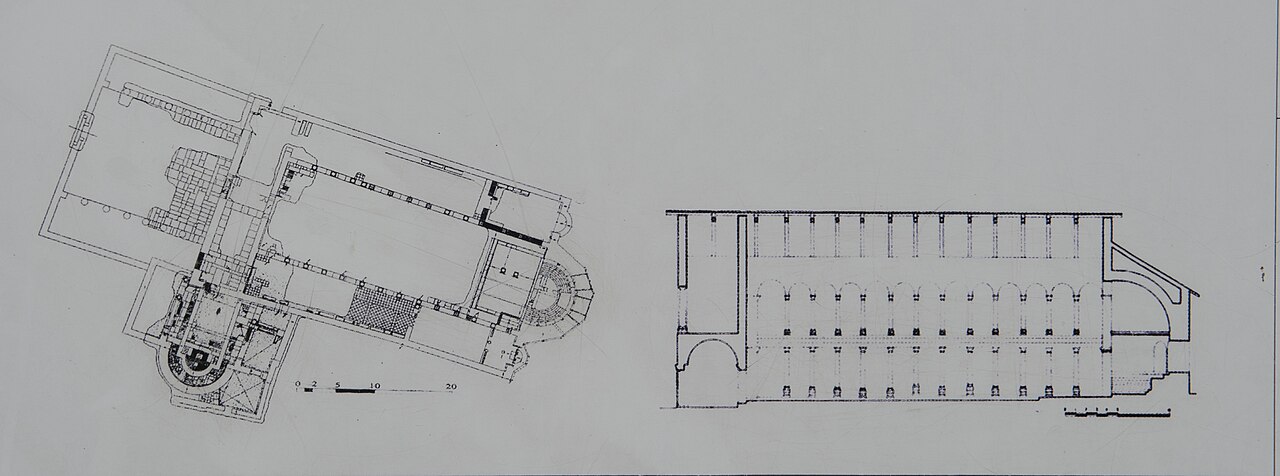
The baptistery gives the cathedral complex a particular function beyond an assembly space. In Christian architecture, a baptistery is associated with the rite of baptism; at Hierapolis UNESCO treats it as part of the remarkable architectural group. At the ruins, ask how the spaces were connected and how a visitor would have moved from the street into a courtyard and then toward the church. The answer depends on archaeological interpretation, not on the impression created by standing walls alone.
A photograph of a plan displayed at the site can help make those relationships legible. It is still worth looking back at the actual terrain after reading the plan. Foundations and fragments that seem abstract in isolation can begin to form a coherent sequence when you compare the courtyard, adjoining rooms and main church area. Take care not to treat every fragment as a surviving sixth-century surface: excavation, weathering and conservation create a layered present-day view.
The second photograph below records the plan in the cathedral area. Use it as an orientation aid rather than a promise that every room is accessible. Site interpretation and visitor paths can change. If a section is fenced or under conservation, observe it from the permitted viewpoint and use the official information available on the day.
Build a thoughtful Pamukkale itinerary
Give the cathedral a place in the same visit as the city's other major remains, rather than treating it as an afterthought following the travertines. The Bath-Basilica near the northern approach offers a useful comparison: it began as a bath and was later adapted as a church, whereas the cathedral and baptistery form another part of the Christian city. Both help explain change over time, but they are separate sites with different architectural stories.
Check current access information from the official museum or site authority shortly before travelling. Opening arrangements, conservation work and the paths between monuments may change. Carry water, wear shoes suitable for uneven ground and allow time to stop at signs. Do not cross barriers to recreate an older photograph. If the cathedral is important to your visit, mention it while planning a private Pamukkale and Hierapolis tour, so the proposed route can be discussed before you travel.
Finally, step back and reconnect the ruins to Pamukkale's wider landscape. UNESCO's inscription recognises the cultural and natural setting together: thermal waters and travertine terraces beside a city whose Roman and Christian monuments remain visible. The cathedral is one way to see that combined place with more depth. It asks you to read a city's long life, not just a striking view.
Sources and further reading
Explore Pamukkale / Hierapolis with context.
Review the route and inclusions before requesting your own private itinerary.
EXPLORE THE PAMUKKALE TOUR